
What hematite is
Hematite is the most important iron ore mineral and one of the most widespread iron oxides on Earth’s surface. Chemically it is Fe2O3, with iron in its fully oxidized ferric state. It crystallizes in the trigonal system, with a hardness of about 5 to 6.5 and a high specific gravity near 5.3. Its name comes from the Greek for “blood,” after the red color of its powder.
Hematite occurs in many forms: metallic plates and rosettes (“specularite” and “iron roses”), rounded botryoidal masses (“kidney ore”), earthy red ochre, and fine inclusions inside other minerals. It forms in igneous, hydrothermal and sedimentary settings and as a weathering product where iron-bearing minerals oxidize[1].
| Chemical formula | Fe2O3 |
|---|---|
| Crystal system | Trigonal |
| Mohs hardness | 5–6.5 |
| Moroccan locality | Recorded at several Moroccan sites, e.g. Kerrouchen basalts; as inclusions in Boudi amethyst |
| Typical habit | Botryoidal masses, metallic plates, earthy masses; tumbled stones |
Hematite in Morocco
Hematite is common in Moroccan rocks and appears in several mineral localities. Mindat lists hematite among the minerals of the Kerrouchen basalts in Khénifra Province, alongside quartz, chalcedony and agate[2]. In the Central Anti-Atlas, the red needle-like inclusions in Boudi amethyst have been identified as hematite[3]. The red color of much of Morocco’s desert landscape and sandstones also comes largely from fine-grained iron oxides. Each listing states the locality supplied for that piece.
Raw versus tumbled
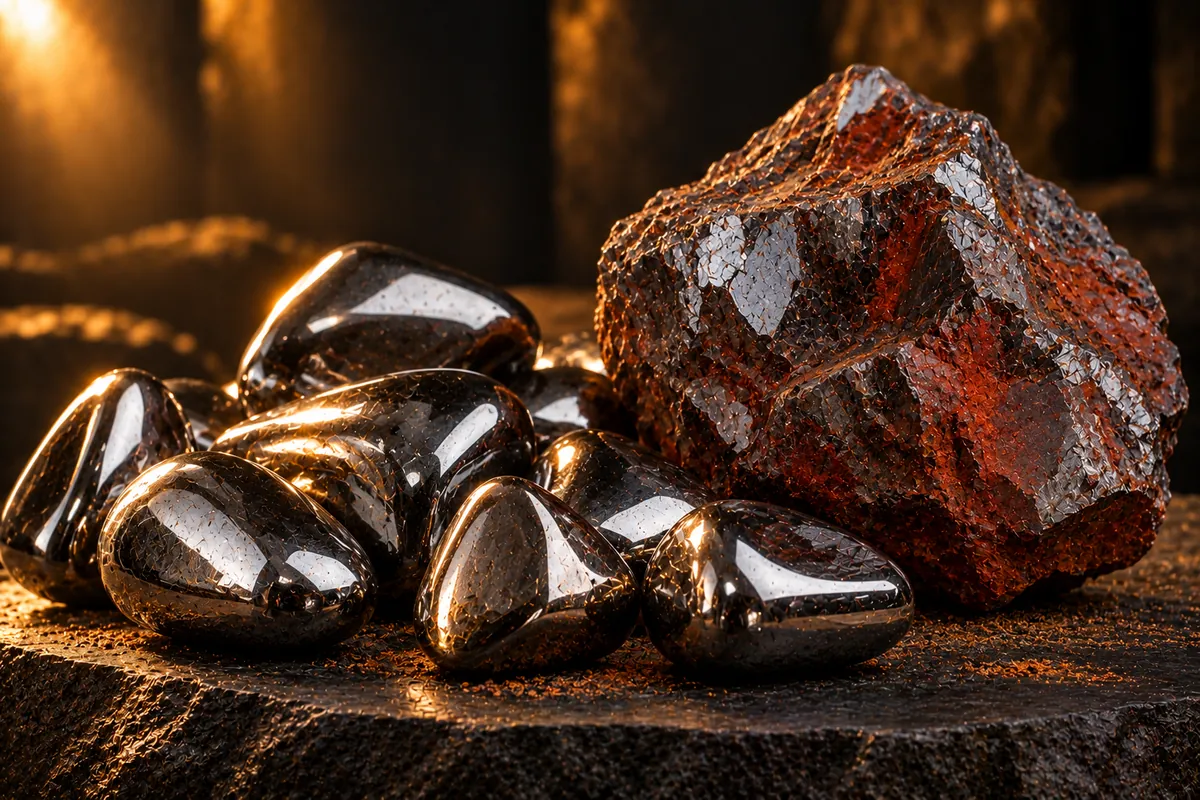
- Raw hematite: natural pieces showing botryoidal, platy or massive textures. Best for collectors, schools and specimen displays.
- Tumbled hematite: rounded and polished in a tumbling barrel to a mirror-like steel-gray luster. Best for counter bowls and jewelry makers.
Natural hematite vs. “hematine”
This is the single most important point for anyone buying hematite. Strongly magnetic beads and tumbled stones sold as “magnetic hematite” or “hematine” are, in most cases, manufactured materials, often ferrite ceramics, not natural hematite. Natural hematite is at most weakly magnetic. Simple checks:
- Magnet test: if a piece snaps firmly onto a small magnet, it is very unlikely to be natural hematite.
- Streak test: rub an unglazed edge on the back of a ceramic tile. Natural hematite leaves a red to red-brown streak; magnetite leaves black.
- Uniformity: identical, flawless shapes in large numbers suggest a molded product.
- Weight: natural hematite feels heavy, but weight alone does not distinguish it.
We sell natural hematite under its own name and label any manufactured product clearly; our listings state whether each piece is natural.
Choosing hematite for resale
For counter bowls, uniform tumbled stones with a bright, even polish sell best; check for pits and chips, which are common in lower grades. For specimen buyers, botryoidal pieces with well-rounded lobes and a strong metallic luster are preferred, and a contrasting matrix adds interest. Label raw pieces with the streak color; it doubles as a quick hands-on lesson for customers.
Care
Hematite is reasonably hard but can scratch or chip on edges. Clean with a dry or slightly damp cloth and dry immediately; earthy and raw pieces may shed red powder, so handle them over paper. Do not store polished hematite loose with harder stones such as quartz.
Wholesale hematite
Tumbled hematite is a consistent seller in bowls and mixed stone assortments; raw pieces add educational value. Apply for a wholesale account for lot pricing and tiered quantity discounts, or use Request a Quote. See also geodes and the full Stones & Rocks range.
References
- Cornell, R.M., & Schwertmann, U. (2003). The Iron Oxides: Structure, Properties, Reactions, Occurrences and Uses, 2nd ed. Weinheim: Wiley-VCH. ISBN 978-3-527-30274-1. wiley-vch.de
- Mindat.org, Hudson Institute of Mineralogy (n.d.). Kerrouchene (Kerrouchen), Khénifra Province, Béni Mellal-Khénifra Region, Morocco. Mindat locality database. Accessed 29 October 2026. mindat.org/loc-108596
- Troilo, F., El Harfi, A., Mouaddib, S., Bittarello, E., & Costa, E. (2015). Amethyst from Boudi, Morocco. Gems & Gemology 51(1): 32–40. doi:10.5741/GEMS.51.1.32
Frequently asked questions
Is magnetic hematite real hematite?
Usually not. Strongly magnetic beads and tumbled stones sold as magnetic hematite or hematine are generally manufactured materials, often ferrite ceramics. Natural hematite is at most weakly magnetic. If a piece clings firmly to a small magnet, it is very unlikely to be natural hematite.
How can I test if hematite is natural?
Do a streak test by rubbing the stone on the unglazed back of a ceramic tile: natural hematite leaves a red to red-brown streak. Check magnetism with a small magnet; natural hematite responds weakly or not at all. Also look for natural texture variation rather than perfectly identical shapes.
Why is hematite gray if its name means blood?
Massive and crystalline hematite looks metallic gray to black, but when powdered it is red, as the streak test shows. The red pigment in many rocks, soils and ochres is fine-grained hematite. The Greek-derived name refers to that blood-red powder, not to the color of the polished stone.
How do I clean tumbled hematite?
Wipe it with a soft dry or slightly damp cloth and dry it straight away, since long contact with water can encourage surface rust stains on some pieces. Avoid harsh cleaners and abrasive pads. Store polished hematite separately from harder stones like quartz so it does not get scratched.