The crow shark
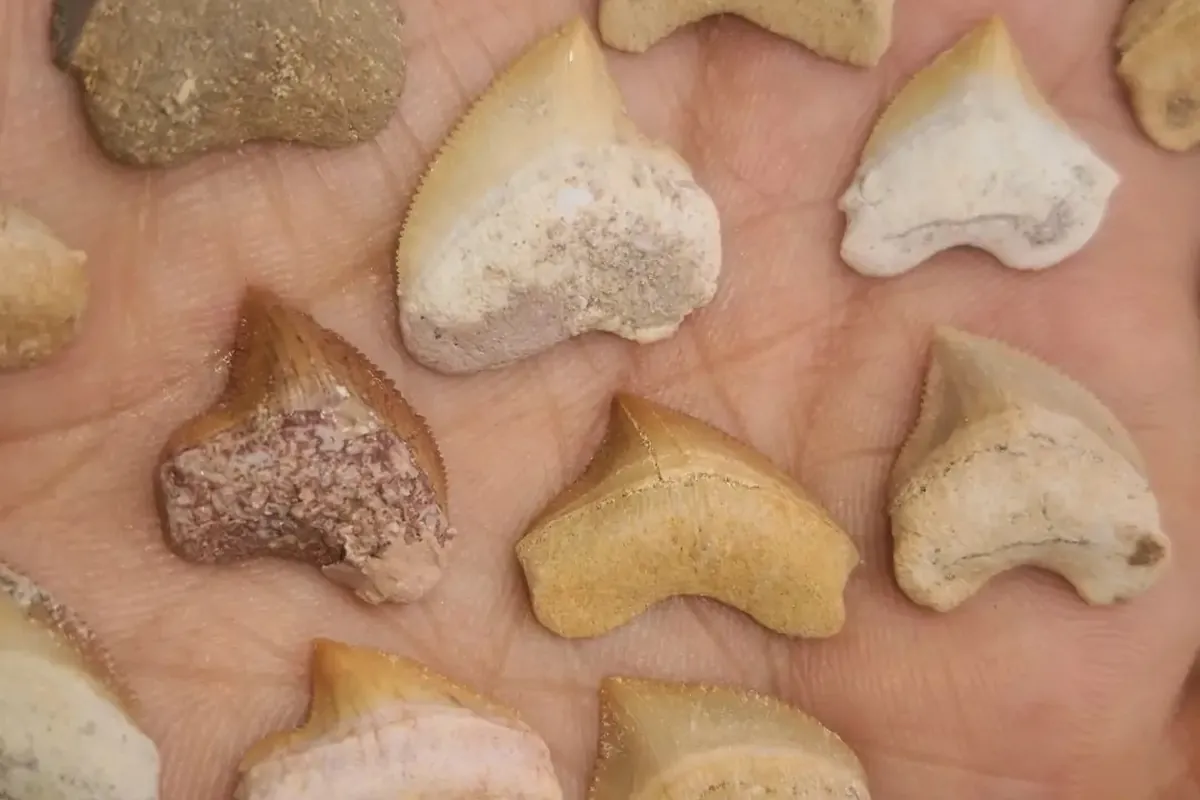
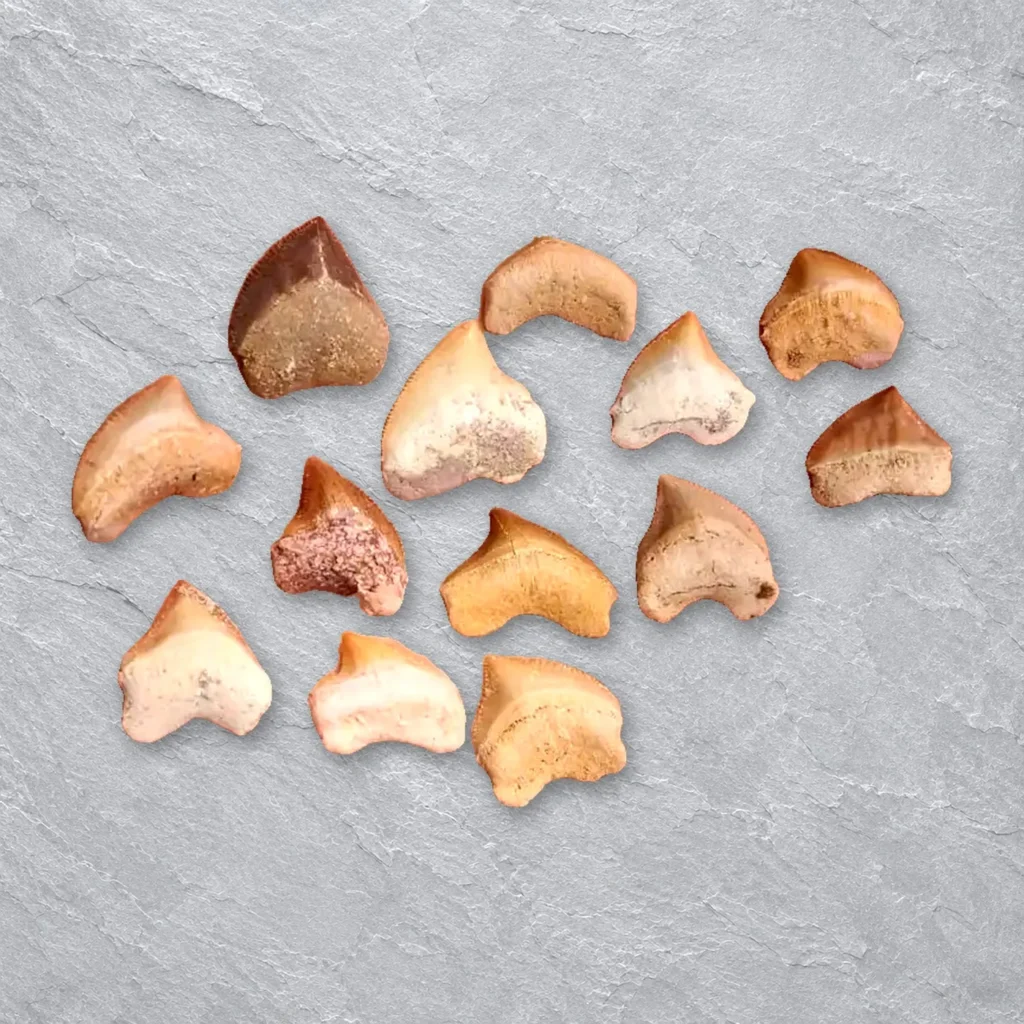
Squalicorax, often called the crow shark, was a Cretaceous shark of the family Anacoracidae. Its teeth are unmistakable: a broad, blade-like crown bent toward the back of the jaw, finely serrated along both edges, with a low “heel” behind the main cusp and a flat root. The overall shape recalls the cutting teeth of a modern tiger shark.
Partial skeletons from the United States have allowed Shimada and Cicimurri to estimate body size and feeding style. A nearly complete skeleton of S. falcatus from Kansas is about 2 m long [1]. Larger species such as S. pristodontus are often estimated at 3 m or more, but those figures are extrapolated from teeth and are uncertain, so big teeth do not translate directly into a known body length. The same study found tiger-shark-like feeding dynamics and scale features suggesting a fast swimmer [1].
Where the classification stands
The skeletal evidence rules out the cow sharks and carpet sharks and places Squalicorax most likely within the Lamniformes or Carcharhiniformes [1]. Most specialists now treat it as a lamniform; the 2014 description of new Moroccan species, for example, classifies Squalicorax in the Lamniformes [4]. Cappetta’s handbook gives the tooth characters used to separate anacoracids from other Cretaceous sharks [2].

Squalicorax in Morocco
In Morocco, Squalicorax teeth come from the Maastrichtian, the last stage of the Cretaceous, in the lower part of the phosphate series of the Oulad Abdoun (Khouribga) and Ganntour (Benguerir) basins. Arambourg’s monograph on the North African phosphates was the first major account of these teeth [3]. The fauna turned out to be more diverse than once thought: in 2014 Cappetta and colleagues described two new species, S. benguerirensis and S. microserratus, from the Lower Maastrichtian of the Benguerir mine, and re-identified some teeth Arambourg had attributed to S. kaupi [4]. Large, coarsely serrated teeth are often sold as S. pristodontus, but unless a tooth is clearly diagnostic, Squalicorax sp. is the more accurate label. Because the genus died out at the end of the Cretaceous, a Squalicorax tooth is also a direct marker of the last dinosaur-age seas, shared with mosasaur teeth from the same levels.
Key facts
| Scientific name | Squalicorax spp. (e.g. S. pristodontus, S. benguerirensis) |
|---|---|
| Family | Anacoracidae |
| Geological age | Maastrichtian, Late Cretaceous (about 72–66 million years) |
| Formation | Moroccan phosphate series, Cretaceous levels |
| Locality in Morocco | Oulad Abdoun Basin (Khouribga); Ganntour Basin (Benguerir) |
| Typical size | about 1–3.5 cm (0.4–1.4 in) across the crown |
What to check when buying a Squalicorax tooth
- Serrations: should run cleanly along both edges. Worn serrations lower the grade but not the authenticity.
- Size versus quality: a sharp, complete 2.5 cm Squalicorax tooth often displays better than a worn 3.5 cm one.
- Pathologies: split or doubled crowns occur naturally and interest specialist collectors.
Variation along the jaw
A single Squalicorax tooth can look quite different from its neighbors. Front teeth are taller and more upright; lateral teeth are lower, broader and more strongly bent toward the back of the jaw, with a longer heel. This range of shapes is one reason species identification from isolated teeth is difficult, and why the 2014 revision re-identified some of Arambourg’s lateral teeth [4]. For buyers, it means a lot of mixed positions is normal and not a sign of mixed sources.
A shark of the last Cretaceous seas
Squalicorax did not survive the end-Cretaceous extinction. In the Moroccan phosphates its teeth are confined to the Cretaceous beds, below the Paleocene layers where Otodus and the sand tigers become common.
Squalicorax teeth wholesale
The Squalicorax tooth sells well in shops because the serrations are easy to show customers and the “dinosaur-age shark” story is accurate. We supply them as single specimens and in size-graded wholesale lots. Approved trade buyers see lot prices and quantity discounts after they apply for a wholesale account; to mix them with Otodus or Cretolamna teeth, request a quote. Return to all Moroccan shark teeth.
References
- Shimada, K. & Cicimurri, D. J. (2005). Skeletal anatomy of the Late Cretaceous shark, Squalicorax (Neoselachii: Anacoracidae). Paläontologische Zeitschrift 79(2): 241–261. doi:10.1007/BF02990187
- Cappetta, H. (2012). Chondrichthyes: Mesozoic and Cenozoic Elasmobranchii: Teeth. Handbook of Paleoichthyology vol. 3E, 512 pp. Munich: Verlag Dr. Friedrich Pfeil. ISBN 978-3-89937-148-2. publisher page
- Arambourg, C. (1952). Les vertébrés fossiles des gisements de phosphates (Maroc–Algérie–Tunisie). Notes et Mémoires du Service Géologique du Maroc 92: 1–372. shark-references.com bibliographic record
- Cappetta, H., Adnet, S., Akkrim, D. & Amalik, M. (2014). New Squalicorax species (Neoselachii: Lamniformes) from the Lower Maastrichtian of Ganntour phosphate deposit, Morocco. PalaeoVertebrata 38(2): e3. doi:10.18563/pv.38.2.e3
Frequently asked questions
Why is Squalicorax called the crow shark?
The genus name combines squalus, shark, and corax, raven or crow, so crow shark is simply a translation of the scientific name. It is not related to any living shark with a similar common name. Squalicorax belongs to the extinct family Anacoracidae and disappeared at the end of the Cretaceous, about 66 million years ago.
How big was Squalicorax?
A nearly complete skeleton of S. falcatus studied by Shimada and Cicimurri is about 2 meters long. Larger species such as S. pristodontus are often estimated at 3 meters or more, but those figures come from tooth size and are uncertain, because tooth size and body length do not scale in a simple way.
Did Squalicorax eat dinosaurs?
Squalicorax is known to have fed on large marine animals and on carcasses. Researchers have reported Squalicorax bite traces on remains of marine reptiles and even on a dinosaur bone that ended up in the sea, which is read as scavenging rather than hunting. Moroccan teeth are shed teeth and carry no direct dietary evidence.
How old are Moroccan Squalicorax teeth?
They come from the Maastrichtian, the final stage of the Cretaceous, roughly 72 to 66 million years ago. In the Moroccan phosphates they come from the Cretaceous levels, below the Paleocene and Eocene beds that produce Otodus and most sand tiger teeth.