What Cretolamna was
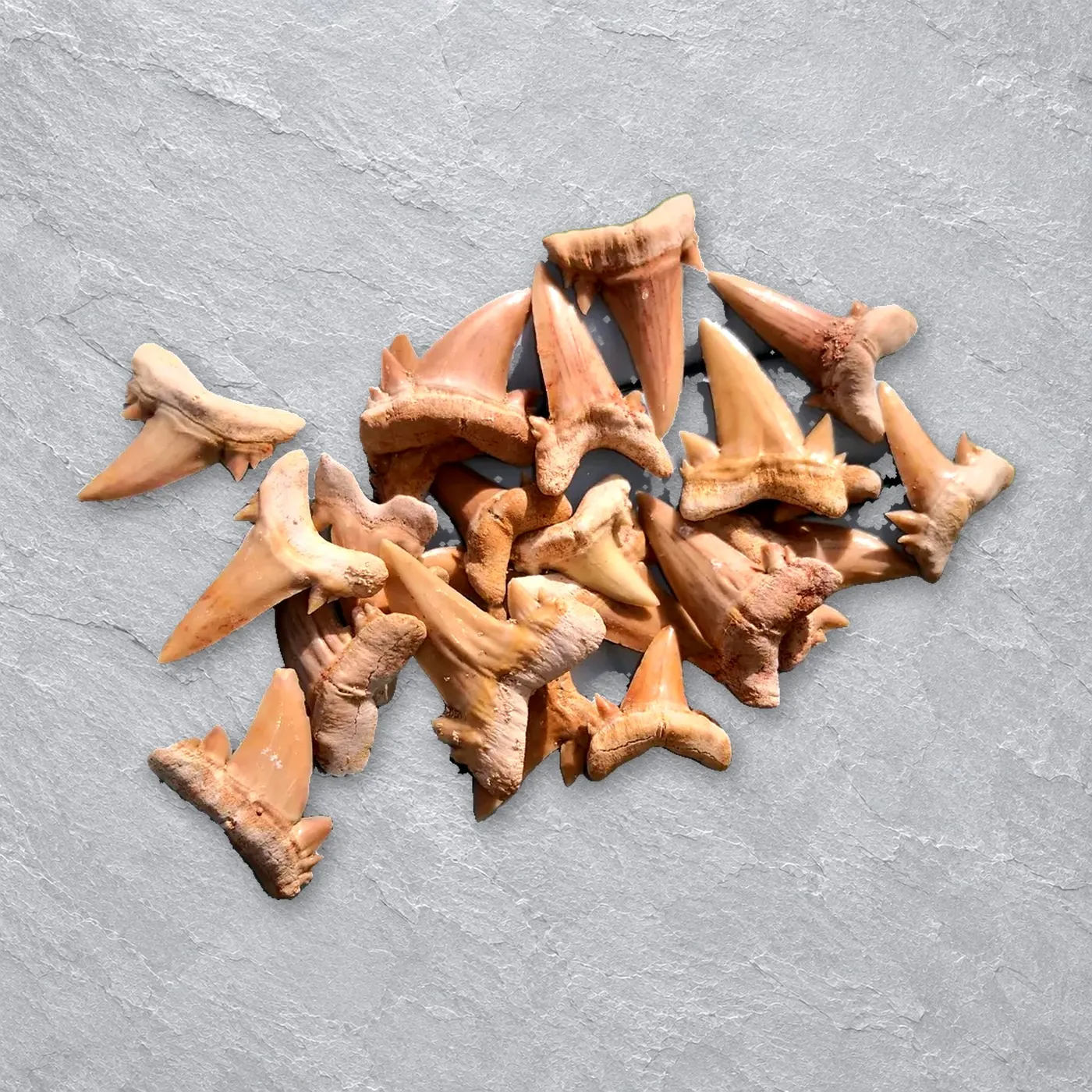
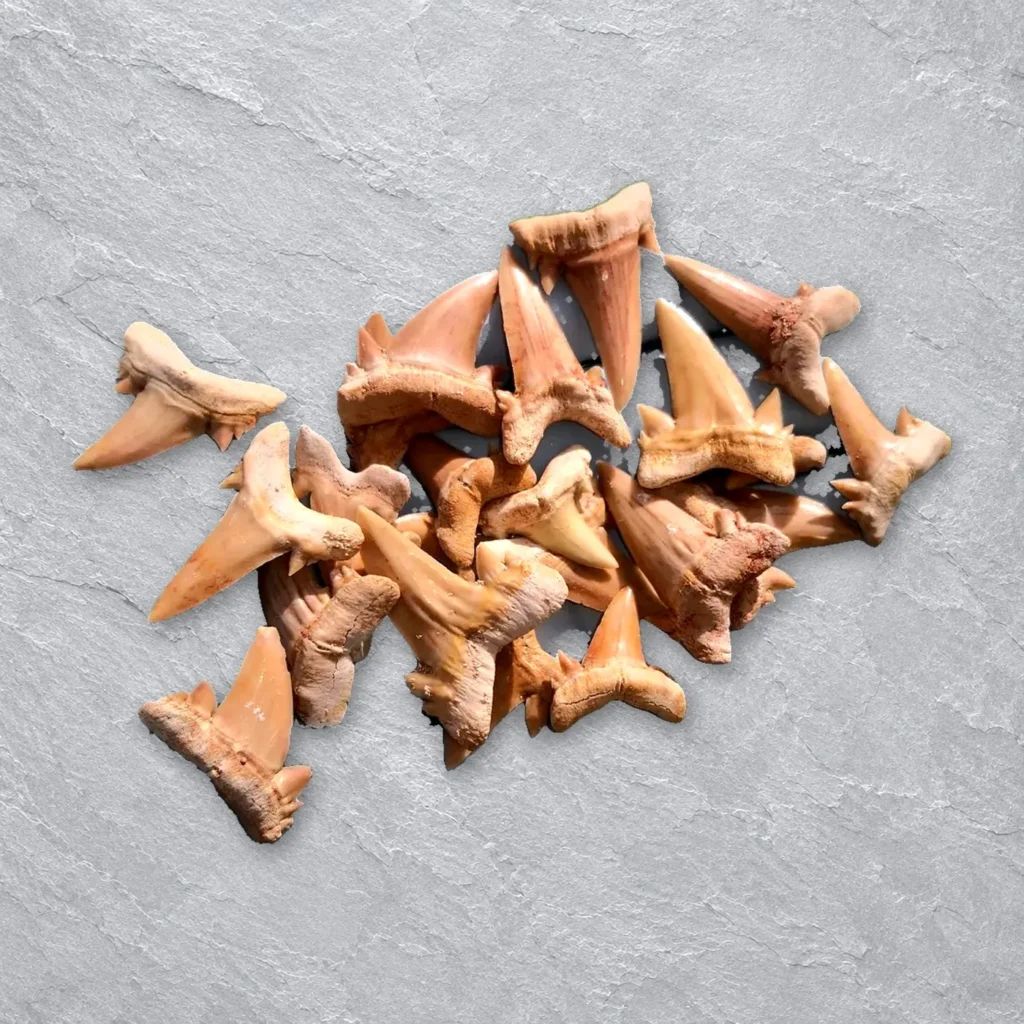
Cretolamna was a mid-sized lamniform shark with a long history: the genus in the strict sense ranges from the Late Albian (Early Cretaceous) into the Ypresian, or possibly the Lutetian, in the Eocene [1]. Its teeth have a triangular, smooth-edged main cusp flanked by one pair of broad, triangular cusplets, set on a root with two well-separated lobes.
The genus belongs to the family Otodontidae. A phylogeny proposed by Shimada and colleagues places it as the closest relative of the group formed by Megalolamna and Otodus [2], and some authors have suggested that Otodus evolved from Cretolamna in the Paleocene [1]. A Cretolamna tooth therefore shows the general plan from which the much larger Otodus teeth developed.
Cretolamna or Cretalamna?
Buyers meet both spellings. The original spelling of the genus name is Cretalamna; Cretolamna became the usual form for decades. Siversson and colleagues reinstated Cretalamna and argue that it is now in prevailing use, while Cappetta’s handbook keeps Cretolamna [1][3]. Both names refer to the same genus. We use the trade spelling in the category name so buyers can find it, and add the alternative in listings.

A species complex, not one species
For decades almost every tooth of this type was called Cretolamna appendiculata, a name stretched over roughly 50 million years. Siversson and colleagues showed that this label covers a complex of several species, and that the root is the most useful feature for telling them apart. Because roots are often worn, many isolated teeth cannot be named to species [1]. Responsible listings therefore use “Cretolamna sp.” or “Cretolamna cf.” unless the tooth is diagnostic. The same paper compares its material with C. arambourgi from the Danian(?) of Youssoufia, Morocco [1].
Key facts
| Scientific name | Cretolamna (also spelled Cretalamna) spp. |
|---|---|
| Family | Otodontidae (Lamniformes) |
| Geological age | Late Cretaceous (Maastrichtian) and Paleocene levels in Morocco |
| Formation | Moroccan phosphate series |
| Locality in Morocco | Oulad Abdoun Basin (Khouribga); Ganntour Basin (Youssoufia) |
| Typical size | about 1.5–3.5 cm (0.6–1.4 in) |
How to recognize a Cretolamna tooth
- Cusplets: one pair, broad and triangular, clearly separated from the main cusp.
- Edges: smooth, without serrations. Serrated teeth of similar size are usually Squalicorax.
- Root: two distinct lobes forming a U or V shape, with a clear groove in the center.
- Color: naturally gray to brown enameloid, tan root. Phosphate staining varies from bed to bed, so a lot will rarely be uniform.
A small Cretolamna tooth can be confused with a young Otodus tooth; those come from younger, Paleogene beds and develop thicker, more massive roots.
A survivor of the end-Cretaceous extinction
Because the genus ranges from the Albian into the Eocene [1], Cretolamna is one of the sharks that crossed the Cretaceous–Paleogene boundary, the mass extinction that ended the non-avian dinosaurs and the mosasaurs. In the Moroccan phosphates the contrast is clear: Squalicorax disappears with the Cretaceous beds, while Cretolamna-type teeth continue into the Paleocene. A Cretolamna tooth from the Maastrichtian and one from the Paleocene, side by side, make a simple and accurate teaching pair about extinction and survival.
Ecologically, Cretolamna was a mid-sized open-water predator. Its cutting-and-grasping dentition probably suited fish and other medium-sized prey, much like many modern lamniform sharks.
Buying Cretolamna shark teeth
The Cretolamna tooth is a good mid-price line for rock shops and education kits: well-shaped, easy to explain, and available in steady numbers. We sell them individually and in size-graded wholesale lots, with locality, age, size, weight and repair status stated. Approved trade buyers see lot pricing after they apply for a wholesale account. Browse all Moroccan shark teeth or wholesale lots.
References
- Siversson, M., Lindgren, J., Newbrey, M. G., Cederström, P. & Cook, T. D. (2015). Cenomanian–Campanian (Late Cretaceous) mid-palaeolatitude sharks of Cretalamna appendiculata type. Acta Palaeontologica Polonica 60(2): 339–384. doi:10.4202/app.2012.0137
- Shimada, K., Chandler, R. E., Lam, O. L. T., Tanaka, T. & Ward, D. J. (2017). A new elusive otodontid shark (Lamniformes: Otodontidae) from the lower Miocene, and comments on the taxonomy of otodontid genera, including the ‘megatoothed’ clade. Historical Biology 29(5): 704–714. doi:10.1080/08912963.2016.1236795
- Cappetta, H. (2012). Chondrichthyes: Mesozoic and Cenozoic Elasmobranchii: Teeth. Handbook of Paleoichthyology vol. 3E, 512 pp. Munich: Verlag Dr. Friedrich Pfeil. ISBN 978-3-89937-148-2. publisher page
Frequently asked questions
Is Cretolamna related to megalodon?
Yes, at the family level. Cretolamna belongs to the Otodontidae, the same family as Otodus and megalodon, and some researchers think Otodus evolved from Cretolamna in the Paleocene. Cretolamna itself was a much smaller shark, and its teeth have smooth edges and broad cusplets rather than the serrated edges of megalodon.
Why are some teeth labeled Cretalamna?
Cretalamna is the original spelling of the genus name. Cretolamna was used for decades, and in 2015 Siversson and colleagues argued for returning to Cretalamna, while Cappetta's 2012 handbook keeps Cretolamna. Both spellings refer to the same genus, so a tooth labeled either way is the same type of fossil.
Can a Cretolamna tooth be identified to species?
Often not. Research has shown that the old name Cretolamna appendiculata covered several species, and the root, the most useful feature for separating them, is often worn on isolated teeth. A label such as Cretolamna sp. is therefore more honest than a confident species name on an average tooth.