
What cow sharks are
Cow sharks, the Hexanchidae, are an old lineage of sharks with six or seven gill slits instead of the usual five and a single dorsal fin set far back on the body. Living representatives include the bluntnose sixgill Hexanchus griseus and the broadnose sevengill. Their fossil record reaches deep into the Mesozoic, and their teeth are among the most distinctive of any shark.
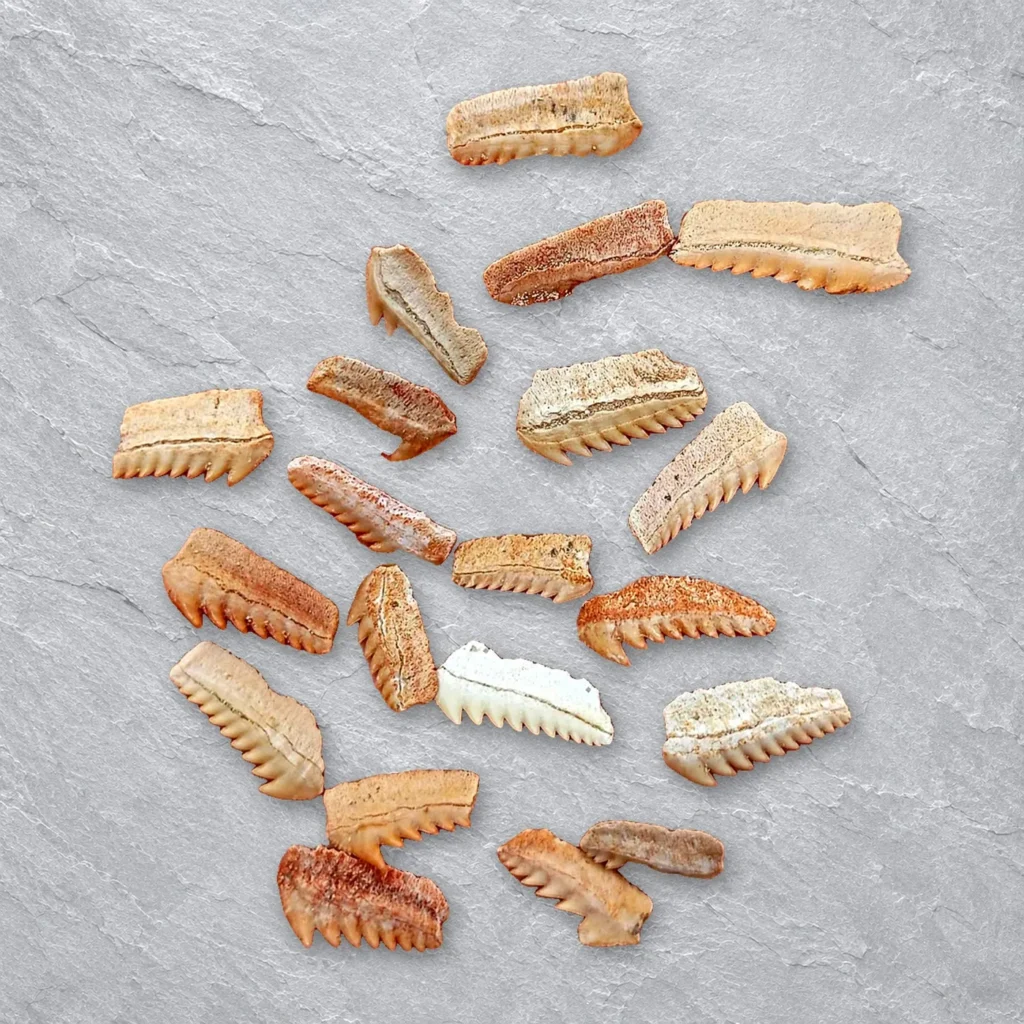
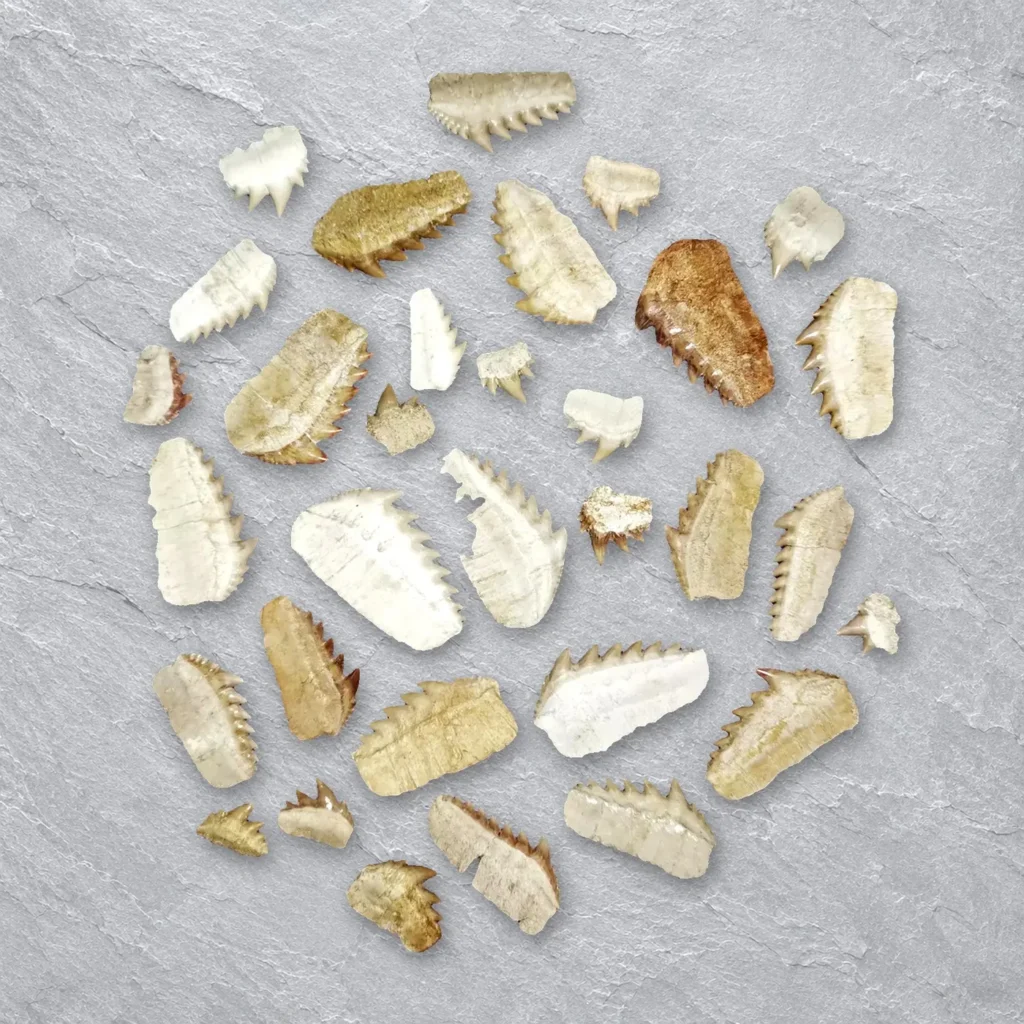
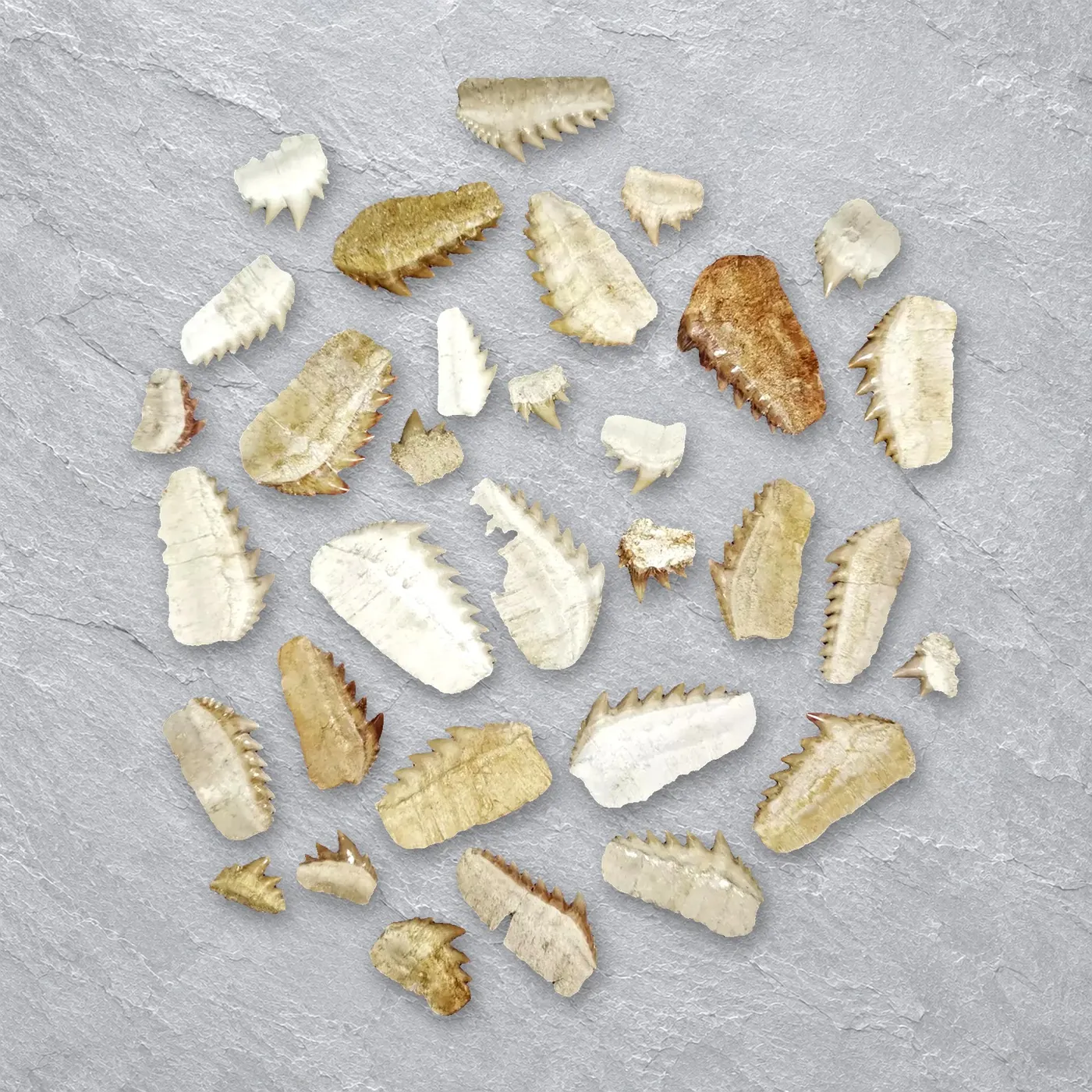
The lower teeth are wide and comb-shaped: a row of cusps that decrease in size toward the back of the tooth, sometimes with small serrations on the front edge. Upper teeth are narrower, with a main cusp and a few smaller cusplets. A single lower tooth can therefore carry many points, which is why collectors prize complete examples.
Genera from the Moroccan phosphates
- Hexanchus: the sixgill sharks. Moroccan teeth from the early Eocene are usually attributed to Hexanchus agassizi. Adnet’s biometric study of fossil and living hexanchids treats H. agassizi as the only Hexanchus species of the Early to Middle Eocene, and suggests that two other named Eocene species may be growth stages of it [1].
- Notidanodon: an extinct hexanchid with large, robust lower teeth bearing a prominent main cusp. Teeth attributed to Notidanodon loozi are reported from the Paleocene of the Oulad Abdoun Basin. They are less common than Hexanchus in Moroccan material.
Both occur in the Paleogene part of the phosphate series, whose ages are constrained by shark biostratigraphy and isotope studies [3]. General identification criteria for hexanchid teeth are given in Cappetta’s handbook [2].
Key facts
| Scientific name | Hexanchus (e.g. H. agassizi), Notidanodon (e.g. N. loozi) |
|---|---|
| Family | Hexanchidae (Hexanchiformes) |
| Geological age | Paleocene to early Eocene in Morocco |
| Formation | Moroccan phosphate series |
| Locality in Morocco | Oulad Abdoun Basin, Khouribga area |
| Typical size | about 1.5–4 cm (0.6–1.6 in) wide for lower teeth |
What makes a good cow shark tooth
Hexanchid teeth are thin and fragile, and the long, low root breaks easily during mining and cleaning. That shapes what you should expect:
- Cusp count: complete lower teeth show the full row of cusps. Missing end cusps are common and reduce value.
- Size and age signals: Adnet found that the number of cusps per millimeter is a better guide to body size than tooth width, and that serrations and an enlarged first cusp can change as the shark grows, so these features need care when naming a species [1].
- Matrix: teeth left partly in phosphate rock are better protected; check that the rock is the original matrix.
An ancient lineage still alive today
Hexanchids are often described as primitive because they keep features lost in most other sharks, such as extra gill slits. Their fossil teeth show that the basic comb-shaped design has changed little over tens of millions of years, so a Moroccan cow shark tooth can be shown next to a photograph of a modern sixgill and the match is obvious. That continuity makes the cow shark tooth a strong teaching specimen.
Upper and lower teeth differ so much that they are sometimes mistaken for different animals. Lower teeth are the wide, comb-like ones most collectors want; upper teeth are narrower, with a dominant cusp and only a few small cusplets.
Cow shark tooth wholesale and display
A fossil cow shark tooth is a strong upgrade item for shops that already sell sand tiger and Otodus teeth: it looks different from every other tooth on the counter and explains shark evolution well. Supply is smaller and less regular, so trade buyers usually order them alongside larger lots. Approved accounts see prices after they apply for a wholesale account; for specific quantities, request a quote. Return to all Moroccan shark teeth.
References
- Adnet, S. (2006). Biometric analysis of the teeth of fossil and Recent hexanchid sharks and its taxonomic implications. Acta Palaeontologica Polonica 51(3): 477–488. app.pan.pl/article/item/app51-477
- Cappetta, H. (2012). Chondrichthyes: Mesozoic and Cenozoic Elasmobranchii: Teeth. Handbook of Paleoichthyology vol. 3E, 512 pp. Munich: Verlag Dr. Friedrich Pfeil. ISBN 978-3-89937-148-2. publisher page
- Kocsis, L., Gheerbrant, E., Mouflih, M., Cappetta, H., Yans, J. & Amaghzaz, M. (2014). Comprehensive stable isotope investigation of marine biogenic apatite from the late Cretaceous–early Eocene phosphate series of Morocco. Palaeogeography, Palaeoclimatology, Palaeoecology 394: 74–88. doi:10.1016/j.palaeo.2013.11.002
Frequently asked questions
Why are they called cow sharks?
Cow shark is the common name for the family Hexanchidae, which includes the living sixgill and sevengill sharks. The name likely reflects their heavy bodies and slow, bottom-hugging habits. They are recognized by six or seven gill slits, a single dorsal fin and comb-shaped lower teeth that are very different from those of other sharks.
Are fossil cow shark teeth rare?
They are much less common than sand tiger or Otodus teeth from the same deposits, and complete teeth are scarcer still because the thin roots and outer cusps break easily. Small or partial teeth are affordable; large, complete lower teeth with every cusp intact are the specimens collectors compete for.
Which Moroccan cow shark species are sold?
Most early Eocene teeth are attributed to Hexanchus agassizi, which a biometric study treats as the only Hexanchus species of that interval. Larger, more robust teeth from Paleocene levels are usually attributed to Notidanodon loozi. Damaged or juvenile teeth are best labeled to genus only.