Dinosaurs of the Kem Kem Group
Nearly all Moroccan dinosaur fossils on the market come from one rock unit: the Kem Kem Group, a long escarpment of sandstones and mudstones along the Moroccan–Algerian border, south of Erfoud and around Taouz. A 2020 monograph divided it into a lower Gara Sbaa Formation and an upper Douira Formation, both of Cenomanian age[1]. Older papers and dealer labels call the same rocks the “Kem Kem beds.” The monograph also notes that “Tafilalt” properly refers to Paleozoic outcrops, not to these dinosaur-bearing layers[1].
The Kem Kem rocks were laid down by rivers and deltas. Fossils are mostly isolated bones and teeth washed into ancient channels, mixed with remains of fish, turtles, crocodile relatives and pterosaurs. The fauna is unusually rich in large predators, and the monograph found no modern land ecosystem that matches it[1].
The predators behind the teeth
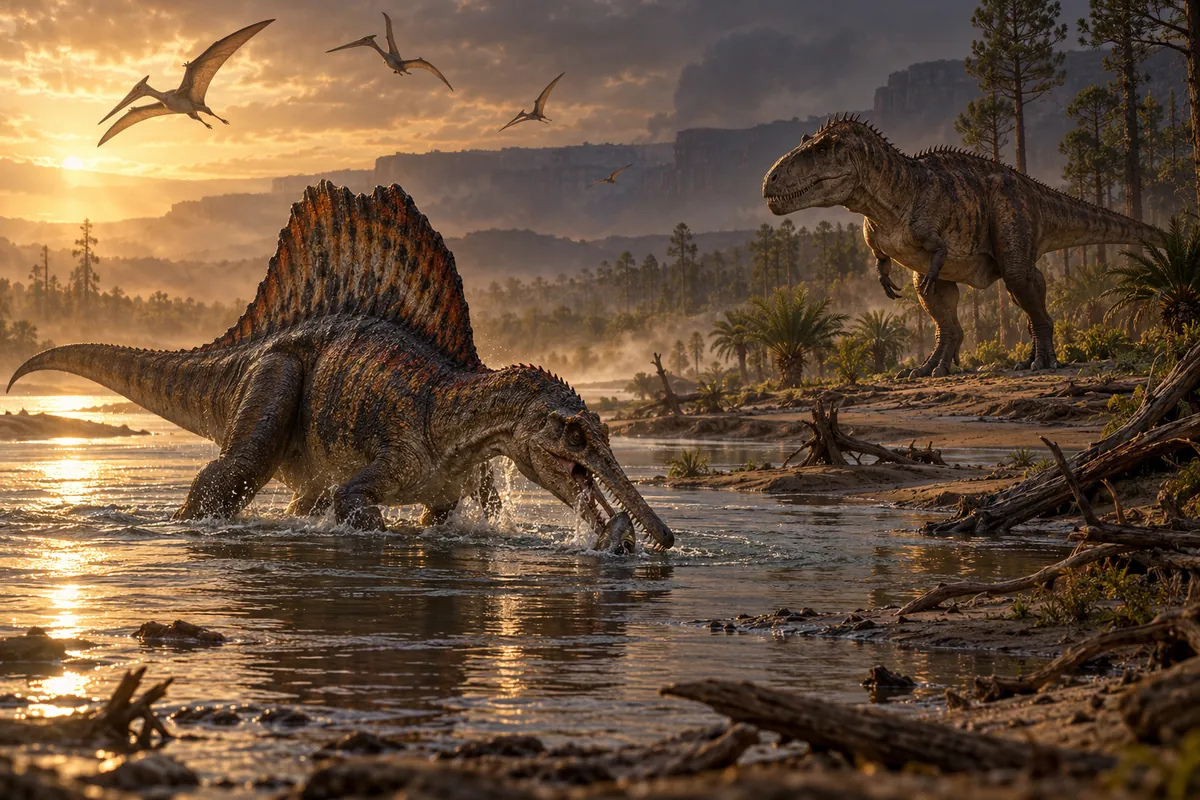
Four groups of meat-eating dinosaurs account for almost everything sold from the Kem Kem:
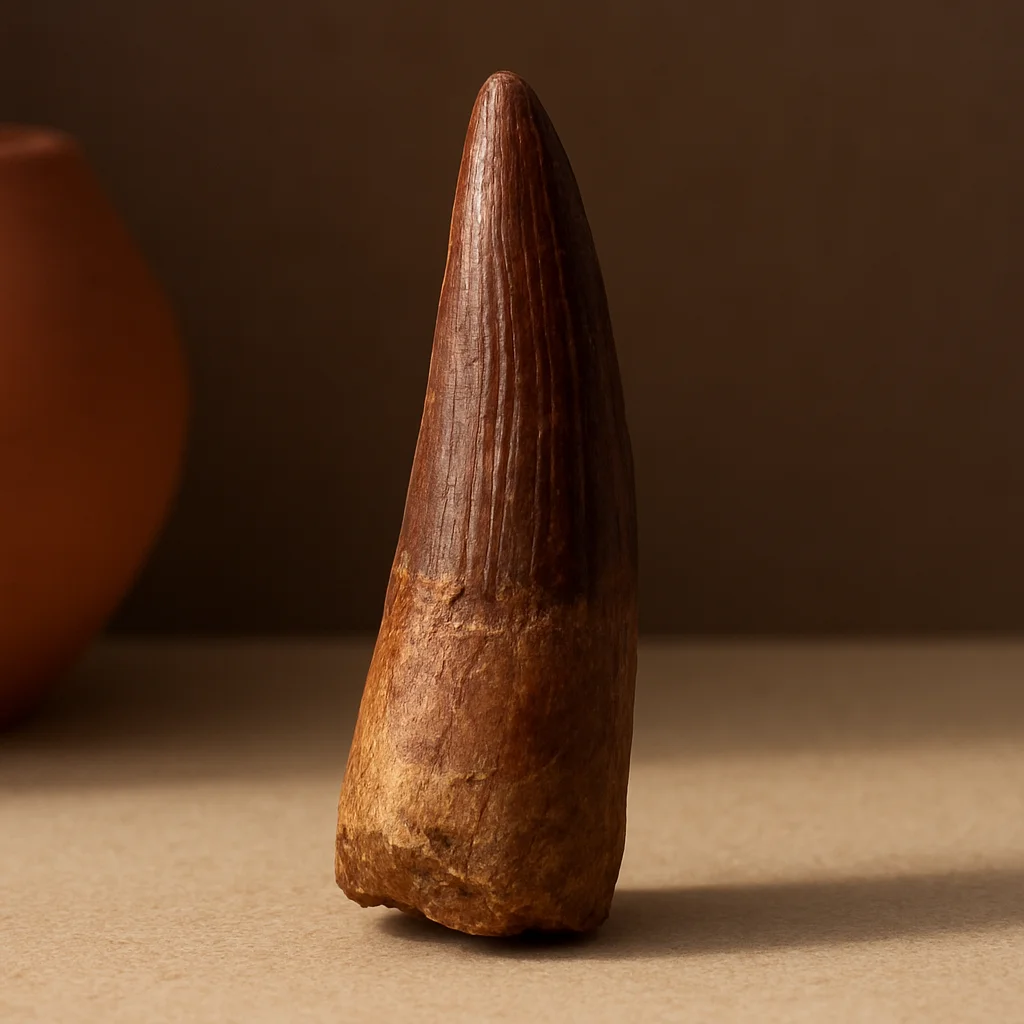
- Spinosaurus teeth: conical, fluted and usually unserrated; the most common dinosaur teeth in the trade.
- Carcharodontosaurus teeth: broad, serrated blades from a giant predator whose partial skull was found in the Kem Kem and described in 1996[2].
- Abelisaurid teeth: short serrated crowns from a family of short-snouted hunters better known from South America.
- Raptor & Deltadromeus teeth: a trade name for small serrated theropod teeth, most of which research shows are not from true raptors[3].
Flying reptiles shared the same rivers. Their teeth are listed under pterosaur fossils, because pterosaurs are not dinosaurs. In many Kem Kem horizons the most common teeth belong to neither group but to the giant sawfish Onchopristis[1]; see Onchopristis sawfish teeth.
How isolated teeth are identified
Because most Moroccan dinosaur fossils are teeth found loose, identification depends on crown shape, serrations and enamel texture rather than on an associated skeleton. A 2024 study that combined phylogenetic, statistical and machine-learning methods confirmed spinosaurine, carcharodontosaurid and abelisaurid teeth in the Kem Kem, and found spinosaurine teeth the easiest to separate[3]. Serrated teeth of the other groups can overlap, so a careful label names only the group the evidence supports.
| Group | Theropod dinosaurs (Spinosauridae, Carcharodontosauridae, Abelisauridae and smaller ceratosaurs) |
|---|---|
| Geological age | Cenomanian, early Late Cretaceous (about 99–94 million years ago) |
| Formation | Kem Kem Group (Gara Sbaa and Douira formations) |
| Locality in Morocco | Kem Kem escarpment, Errachidia Province, southeastern Morocco (Taouz–Begaa area) |
| Typical size | Isolated teeth, mostly 1–8 cm; large complete teeth are uncommon |
Repairs, composites and honest labeling of Moroccan dinosaur fossils
Commercial collecting in the Kem Kem was already well established by the mid-1990s[1], and most teeth reach the market through local fossil miners. Many are found broken and later glued; some sellers also fill gaps, sculpt missing tips or attach roots from other teeth. Every listing in this category states locality, geological age, size, weight and whether the piece is natural, repaired or restored. Consistent color and texture, a clean crown-to-root transition and no heavy matrix hiding part of the tooth are good signs.
Moroccan dinosaur fossils for resellers
Rock shops, museum stores and online sellers can buy Kem Kem teeth in quantity through a wholesale account, with tiered discounts by volume, or browse wholesale lots. For specific sizes or mixed assortments, request a quote. Shipments to the USA and Europe travel with legal Moroccan export paperwork; details are on our shipping page.
References
- Ibrahim, N., Sereno, P.C., Varricchio, D.J., Martill, D.M., Dutheil, D.B., Unwin, D.M., Baidder, L., Larsson, H.C.E., Zouhri, S. & Kaoukaya, A. (2020). Geology and paleontology of the Upper Cretaceous Kem Kem Group of eastern Morocco. ZooKeys 928: 1–216. doi:10.3897/zookeys.928.47517
- Sereno, P.C., Dutheil, D.B., Iarochene, M., et al. (1996). Predatory dinosaurs from the Sahara and Late Cretaceous faunal differentiation. Science 272(5264): 986–991. doi:10.1126/science.272.5264.986
- Hendrickx, C., Trapman, T.H., Wills, S., Holwerda, F.M., Stein, K.H.W., Rauhut, O.W.M., Melzer, R.R., Van Woensel, J. & Reumer, J.W.F. (2024). A combined approach to identify isolated theropod teeth from the Cenomanian Kem Kem Group of Morocco: cladistic, discriminant, and machine learning analyses. Journal of Vertebrate Paleontology 43(4): e2311791. doi:10.1080/02724634.2024.2311791
Frequently asked questions
Where do Moroccan dinosaur fossils come from?
Almost all of them come from the Kem Kem Group, a band of Cretaceous river and delta deposits along Morocco's southeastern border with Algeria, around Taouz and south of Erfoud in Errachidia Province. The rocks are Cenomanian in age, roughly 99 to 94 million years old, and yield mostly isolated teeth and bones rather than complete skeletons.
Why are most Moroccan dinosaur fossils teeth?
Theropod dinosaurs replaced their teeth throughout life, so each animal shed many teeth. Teeth are also made of hard enamel and dentine that survive transport in rivers far better than bone. In the Kem Kem, fossils were concentrated in ancient river channels, where durable teeth are by far the most common vertebrate remains.
Is it legal to buy and import Moroccan dinosaur teeth?
Kem Kem teeth are traded internationally, and our shipments leave Morocco with legal export paperwork. Import rules for fossils vary by country, so buyers, especially businesses importing in volume, should check their own customs requirements. Our shipping page explains the documents that travel with each order.
How can I tell if a dinosaur tooth has been restored?
Look for color or texture changes across the tooth, filler at the junction between crown and root, unnaturally perfect tips, and thick matrix covering part of the specimen, which can hide repairs. Glued breaks are common and acceptable when disclosed. Every listing here states whether the piece is natural, repaired or restored.