
Flying reptiles, not dinosaurs
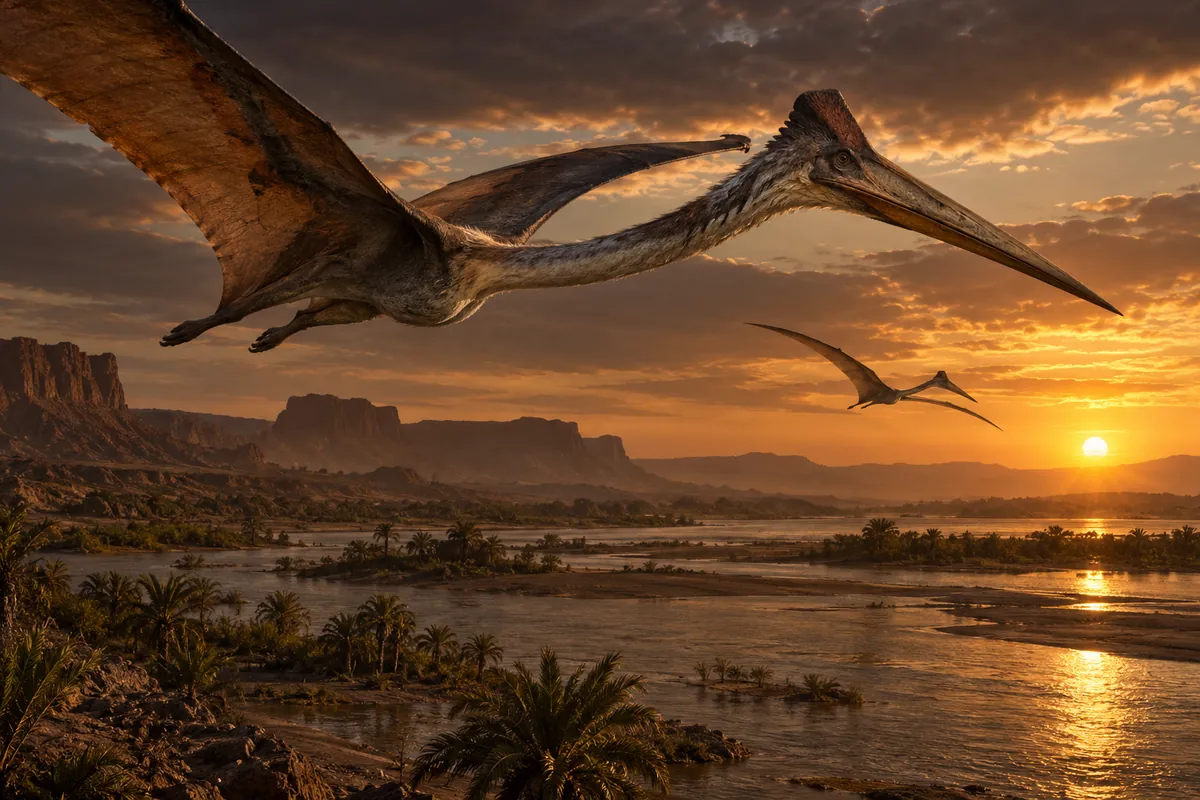
Pterosaurs were the first vertebrates to evolve powered flight, with wings made of a skin membrane stretched from a greatly lengthened fourth finger. They were close relatives of dinosaurs and lived alongside them throughout the Mesozoic, but they form a separate branch of reptiles. That is why we list them apart from our dinosaur fossils, even though both come from the same Moroccan rocks.
Pterosaurs of the Kem Kem
The Kem Kem Group has produced one of the richest pterosaur faunas known from Africa: at least nine species, including five toothed ornithocheirids and at least four toothless azhdarchids[1]. Toothed forms reported from the beds include Siroccopteryx and Coloborhynchus, along with jaw fragments resembling Anhanguera, previously known from Brazil, and Ornithocheirus, previously known from England and Central Asia[1].
The best-known Kem Kem azhdarchid is Alanqa saharica, named in 2010 from a long, straight, lance-shaped lower-jaw tip found at Aferdou N’Chaft. Most of its remains suggest a wingspan of about 3 to 4 meters, while a neck vertebra points to individuals of about 6 meters[2]. Azhdarchids had toothless beaks, so Alanqa did not produce the teeth seen in the trade.
Pterosaur teeth in the fossil trade
Almost all pterosaur teeth sold from Morocco belong to ornithocheirids. They are long, slender, gently curved cones, round to oval in cross-section, with smooth or finely striated enamel and no serrations, a shape generally interpreted as suited to seizing fish. Dealers often label them Siroccopteryx or “Coloborhynchus moroccensis.” Because several ornithocheirids lived in the Kem Kem at the same time, an isolated tooth cannot be assigned to one genus with confidence; “Ornithocheiridae” is the accurate identification[1].
Pterosaur bones were thin-walled and hollow, so they rarely survived river transport intact. Kem Kem pterosaur remains are mostly isolated teeth, jaw fragments and broken bones, recovered alongside dinosaurs, crocodile relatives and fish[3].
| Scientific name | Pterosauria: Ornithocheiridae (toothed); Azhdarchidae, e.g. Alanqa saharica (toothless) |
|---|---|
| Geological age | Cenomanian, early Late Cretaceous (about 99–94 million years ago) |
| Formation | Kem Kem Group (Gara Sbaa and Douira formations) |
| Locality in Morocco | Kem Kem escarpment, Errachidia Province, southeastern Morocco (Taouz–Begaa area) |
| Typical size | Teeth mostly 1–4 cm |
| Wingspan | Alanqa: about 3–4 m, some individuals about 6 m |
Buying pterosaur teeth
- Shape. Pterosaur teeth are slimmer and straighter than Spinosaurus teeth and lack their coarse flutes.
- Not crocodile. Crocodyliform teeth from the same beds are stouter, more conical and often show cutting ridges; see crocodile fossils.
- Tips and repairs. The thin tips break easily. Check whether the tip is original and whether any break has been glued or filled.
- Labels. Treat a confident genus name on an isolated tooth with caution.
Every listing states locality, age, size, weight and whether the specimen is natural, repaired or restored.
Pterosaur teeth wholesale
Pterosaur teeth add a flying reptile to any Kem Kem display. Approved buyers with a wholesale account receive tiered discounts by quantity; for a set number or size range, request a quote or browse wholesale lots.
References
- Jacobs, M.L., Martill, D.M., Unwin, D.M., Ibrahim, N., Zouhri, S. & Longrich, N.R. (2020). New toothed pterosaurs (Pterosauria: Ornithocheiridae) from the middle Cretaceous Kem Kem beds of Morocco and implications for pterosaur palaeobiogeography and diversity. Cretaceous Research 110: 104413. doi:10.1016/j.cretres.2020.104413
- Ibrahim, N., Unwin, D.M., Martill, D.M., Baidder, L. & Zouhri, S. (2010). A new pterosaur (Pterodactyloidea: Azhdarchidae) from the Upper Cretaceous of Morocco. PLoS ONE 5(5): e10875. doi:10.1371/journal.pone.0010875
- Ibrahim, N., Sereno, P.C., Varricchio, D.J., Martill, D.M., Dutheil, D.B., Unwin, D.M., Baidder, L., Larsson, H.C.E., Zouhri, S. & Kaoukaya, A. (2020). Geology and paleontology of the Upper Cretaceous Kem Kem Group of eastern Morocco. ZooKeys 928: 1–216. doi:10.3897/zookeys.928.47517
Frequently asked questions
Are pterosaurs dinosaurs?
No. Pterosaurs were flying reptiles and close relatives of dinosaurs, but they belong to a separate branch of the reptile family tree. They evolved flight independently of birds, using a wing membrane supported by a very long fourth finger. Dinosaurs and pterosaurs lived together, and both are found in Morocco's Kem Kem Group.
Which pterosaur does a Moroccan pterosaur tooth come from?
Most come from ornithocheirids, toothed fish-eating pterosaurs. Dealers often use the names Siroccopteryx or Coloborhynchus, but at least five ornithocheirids are known from the Kem Kem, so an isolated tooth cannot be pinned to one genus. Alanqa, the best-known Moroccan pterosaur, was a toothless azhdarchid and did not produce these teeth.
How can I tell a pterosaur tooth from a crocodile or Spinosaurus tooth?
Pterosaur teeth are slender, gently curved and smooth or finely striated, without serrations. Crocodile teeth from the Kem Kem are stouter and more conical, often with cutting ridges. Spinosaurus teeth are larger and thicker, with pronounced lengthwise flutes. Comparing the cross-section and the base usually settles the question.