

What makes a Spinosaurus tooth
Spinosaurus teeth are easy to recognize once you have handled a few. The crown is a tall, gently curved cone, close to round in cross-section, with fine lengthwise ridges (flutes) in the enamel. Unlike the blade-like teeth of most large theropods, the edges usually lack serrations[1]. This shape suits gripping slippery or hard-bodied prey rather than slicing flesh, and spinosaurine teeth appear to have been replaced quickly, which helps explain why so many are found.
Color depends on the layer: chocolate brown, caramel, blue-gray or nearly black enamel, sometimes with a paler root. Many teeth show feeding wear at the tip, a natural feature showing the tooth was used in life.
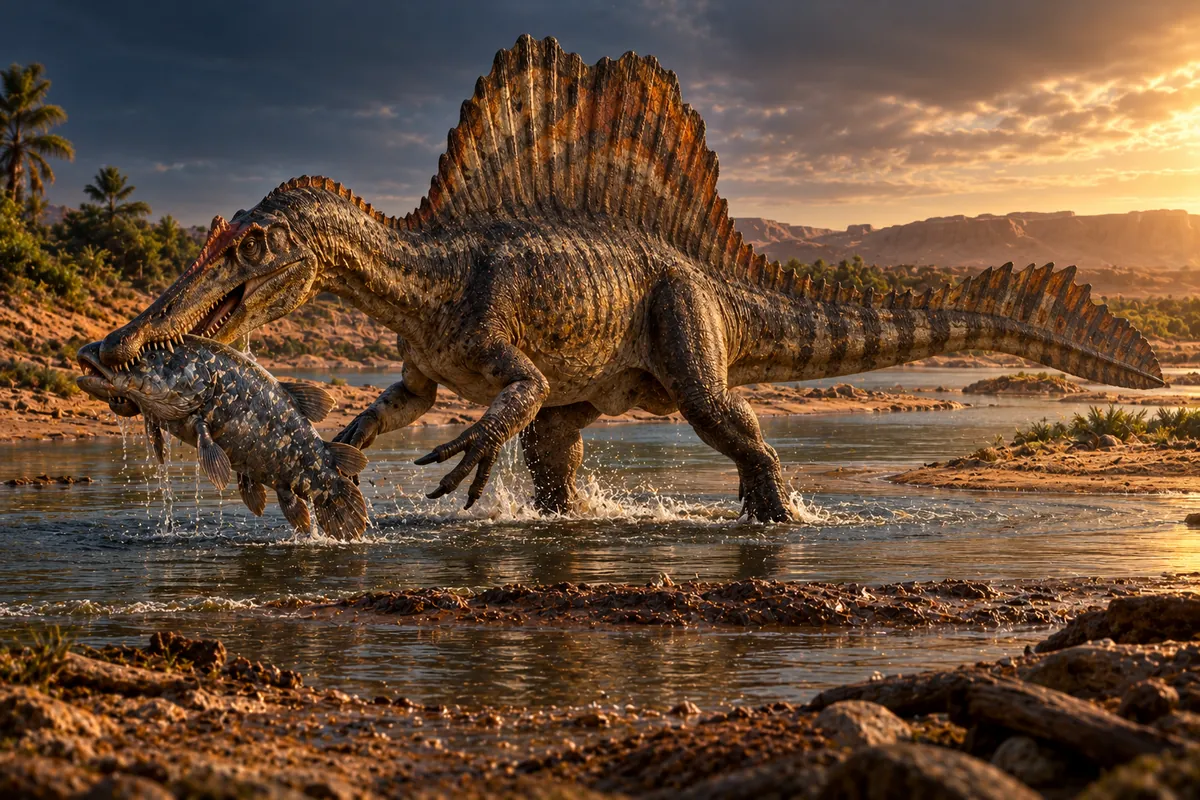
The animal: Spinosaurus aegyptiacus
Spinosaurus was first described from Egypt, but its original fossils were destroyed during the Second World War. Since then, Morocco has become central to its study. A partial skeleton from the Kem Kem, described in 2014, was expanded in 2020 with a nearly complete tail. That tail has very tall spines and long chevron bones forming a flexible, fin-like structure, and robotic-model tests found it produced more thrust in water than the tails of land-dwelling dinosaurs[2].
Swimmer or wader? An open debate
How Spinosaurus lived is one of the liveliest questions in paleontology. Ibrahim and colleagues read the tail as evidence of a tail-propelled aquatic predator[2]. A count of fossil teeth near Tarda, on the edge of the Tafilalt, found Spinosaurus teeth so abundant that at one site they outnumbered the rostral “teeth” of the sawfish Onchopristis; the authors argue this fits an animal that spent much of its life in water[3].
Other researchers disagree. Hone and Holtz concluded that it was a shoreline generalist that fed mainly from the water while wading, somewhat like a giant heron, with no evidence for active underwater pursuit[1]. Sereno and colleagues modeled its body and found it would have been unstable in deep water and too buoyant to dive, describing a semiaquatic, bipedal ambush predator of rivers and lakes[4]. All sides agree that fish were a major part of its diet.
Which species?
An isolated tooth cannot be identified to species. Some researchers recognize a second spinosaurid, Sigilmassasaurus, in the Kem Kem, while others place all the material in Spinosaurus aegyptiacus. “Spinosaurus tooth” is the accepted trade and museum label; strictly speaking, these are spinosaurine teeth.
| Scientific name | Spinosaurus aegyptiacus (Spinosauridae: Spinosaurinae) |
|---|---|
| Geological age | Cenomanian, early Late Cretaceous (about 99–94 million years ago) |
| Formation | Kem Kem Group (Gara Sbaa and Douira formations) |
| Locality in Morocco | Kem Kem escarpment, Errachidia Province, southeastern Morocco (Taouz–Begaa area) |
| Typical size | Most teeth 2.5–8 cm (1–3 in); teeth over 10 cm (4 in) are rare |
| Tooth features | Conical, fluted enamel, usually unserrated |
Buying Spinosaurus teeth: what to check
- Size and completeness. Value climbs steeply with length. Large, complete teeth with intact tips are uncommon.
- Repairs. Many teeth are found broken and glued. A clean glued break is normal; filled gaps, rebuilt enamel or sculpted tips should always be disclosed.
- Composites. Some sellers join parts of different teeth or add a root from another tooth. Warning signs are mismatched color or texture, a lumpy crown-to-root junction and thick matrix over part of the tooth.
- Roots. Genuine roots are usually hollow and thin-walled and are not perfectly round. A long, solid, cylindrical “root” on an inexpensive tooth is a red flag.
- Photos. Ask for images of all sides, including the base, before buying an expensive tooth.
Every listing on this page states locality, age, size, weight and whether the tooth is natural, repaired or restored.
Spinosaurus teeth wholesale
Rock shops, museum stores and online sellers often stock Spinosaurus teeth in size-graded quantities. Approved buyers with a wholesale account receive tiered discounts by volume; for particular sizes or mixed Kem Kem assortments, request a quote or browse wholesale lots. Related categories: Carcharodontosaurus teeth, the parent Moroccan dinosaur fossils page and the Kem Kem sawfish Onchopristis teeth.
References
- Hone, D.W.E. & Holtz, T.R., Jr. (2021). Evaluating the ecology of Spinosaurus: shoreline generalist or aquatic pursuit specialist? Palaeontologia Electronica 24(1): a03. doi:10.26879/1110
- Ibrahim, N., Maganuco, S., Dal Sasso, C., Fabbri, M., Auditore, M., Bindellini, G., Martill, D.M., Zouhri, S., et al. (2020). Tail-propelled aquatic locomotion in a theropod dinosaur. Nature 581(7806): 67–70. doi:10.1038/s41586-020-2190-3
- Beevor, T., Quigley, A., Smith, R.E., Smyth, R.S.H., Ibrahim, N., Zouhri, S. & Martill, D.M. (2021). Taphonomic evidence supports an aquatic lifestyle for Spinosaurus. Cretaceous Research 117: 104627. doi:10.1016/j.cretres.2020.104627
- Sereno, P.C., Myhrvold, N., Henderson, D.M., et al. (2022). Spinosaurus is not an aquatic dinosaur. eLife 11: e80092. doi:10.7554/eLife.80092
Frequently asked questions
How can I tell a Spinosaurus tooth from other dinosaur teeth?
Spinosaurus teeth are conical and nearly round in cross-section, with lengthwise flutes in the enamel and usually no serrations. Carcharodontosaurus and abelisaurid teeth from the same beds are flattened blades with serrated edges. Crocodile teeth can look similar but are usually shorter, stouter and lack the fine fluting of a spinosaur crown.
Why are Spinosaurus teeth so common?
Spinosaurines replaced their teeth unusually quickly, and the animals lived along rivers where shed teeth were buried in channel sands. One study near Tarda found Spinosaurus teeth abundant enough to outnumber sawfish rostral teeth at one site, which its authors link to a largely aquatic lifestyle. Large, complete teeth are still uncommon.
Are Spinosaurus teeth often repaired?
Yes. Many teeth break during burial or excavation and are glued back together, which is normal when disclosed. More extensive work, such as filled gaps, rebuilt tips or added roots, changes the value considerably. Every tooth in this category is labeled natural, repaired or restored so you know exactly what you are buying.
Was Spinosaurus a swimming dinosaur?
This is still debated. One team argues its fin-like tail made it an active aquatic predator. Others conclude it waded and hunted from the shoreline or in shallow water, and was too buoyant and unstable to dive. Researchers agree it lived near water and ate a lot of fish.