
Who were the abelisaurids?
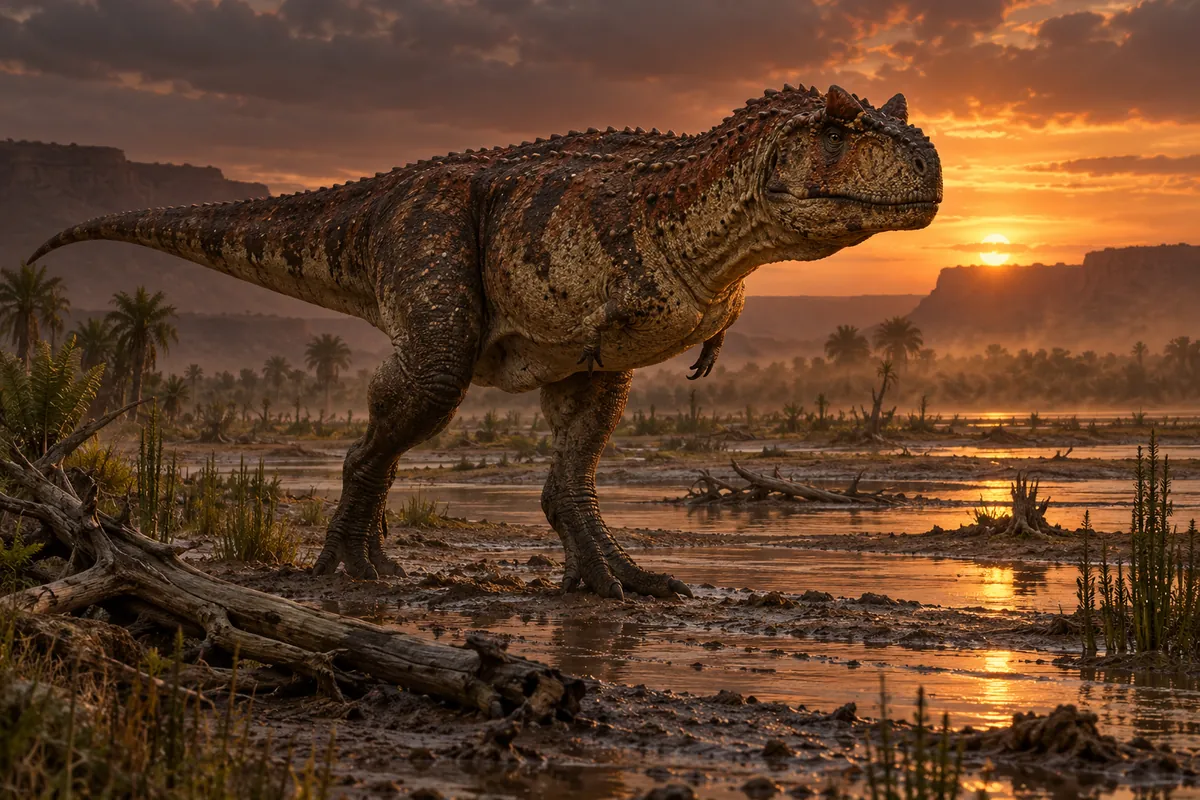
Abelisaurids were ceratosaurian theropods with short, deep skulls, often roughened or crested, and strikingly small forelimbs. The family is best known from South America, India and Madagascar, with Carnotaurus of Argentina the most familiar example. In North Africa their record is mostly fragmentary. A partial thigh bone collected south of Taouz and described in 2016 came from an animal comparable in size to Carnotaurus, about 9 meters long, showing that large abelisaurids shared the Kem Kem rivers with carcharodontosaurids and spinosaurids[1]. Isolated abelisaurid bones had already been reported from the same beds[2].
Recognizing abelisaurid teeth
Abelisaurid teeth are blade-like and serrated on both edges, but the crowns are usually shorter and less hooked than those of Carcharodontosaurus. In side view the front edge curves strongly toward the tip, while the back edge is nearly straight, so the tip sits close above the rear of the base. Enamel is often brown to gray, and serrations are fine and regular.
Identification from shape alone is difficult. A 2024 study of isolated Kem Kem teeth found that abelisaurid and carcharodontosaurid teeth could be separated reliably only with machine-learning and phylogenetic analyses, not with simple measurements. The same project reassigned mystery tooth types once attributed to dromaeosaurids (“raptors”) to abelisaurids and noasaurids[3]. In practice, small serrated Kem Kem teeth sold as raptor teeth may be abelisaurid, and medium-sized abelisaurid teeth are sometimes sold as small Carcharodontosaurus teeth.
Why the label matters
Collectors seek abelisaurid teeth because they represent a different branch of the theropod family tree from Spinosaurus and Carcharodontosaurus, completing a set of the Kem Kem’s large predators. No abelisaurid genus has been named from Kem Kem teeth, so a genus name on a Moroccan abelisaurid tooth is a guess. A careful label reads “Abelisauridae indet.” and should say when even that attribution is tentative.
Abelisaurids and carcharodontosaurids together
The Moroccan femur adds to a broader pattern. Chiarenza and Cau noted that abelisaurids and carcharodontosaurids overlapped in both North Africa and South America during the mid-Cretaceous, suggesting that this pairing of large predators was typical of Gondwanan ecosystems at the time[1]. Spinosaurids complete the Kem Kem picture, making it one of the few places where teeth of all three groups can be collected from the same rocks. The 2024 tooth study found that spinosaurine teeth were separated by every method tested, while the two serrated groups overlapped much more[3], which is why these teeth reward close inspection.
| Scientific name | Abelisauridae indet. (Ceratosauria) |
|---|---|
| Geological age | Cenomanian, early Late Cretaceous (about 99–94 million years ago) |
| Formation | Kem Kem Group (Gara Sbaa and Douira formations) |
| Locality in Morocco | Kem Kem escarpment, Errachidia Province, southeastern Morocco (Taouz–Begaa area) |
| Typical size | Crowns mostly 1–5 cm |
| Animal size | Largest Kem Kem individuals about 9 m long (femur estimate) |
Buying abelisaurid teeth
- Shape first. Look for a short, broad crown with a strongly curved front edge and a nearly straight back edge.
- Serrations. Both edges should be serrated; check them under a hand lens for wear or rebuilt sections.
- Restoration. Abelisaurid teeth are smaller than most Spinosaurus teeth and are less often heavily restored, but glued breaks and tip repairs occur. Ask what has been done.
- Labels. Be cautious with genus names; family-level identification is the honest standard.
Every listing in this category states locality, age, size, weight and whether the tooth is natural, repaired or restored.
Abelisaurid teeth for resellers
Abelisaurid teeth are less common than Spinosaurus teeth and are usually offered individually or within mixed Kem Kem theropod assortments. Shops and museum stores can order through a wholesale account with tiered quantity discounts, or request a quote for a specific selection. See also Spinosaurus teeth and all Moroccan dinosaur fossils.
References
- Chiarenza, A.A. & Cau, A. (2016). A large abelisaurid (Dinosauria, Theropoda) from Morocco and comments on the Cenomanian theropods from North Africa. PeerJ 4: e1754. doi:10.7717/peerj.1754
- Ibrahim, N., Sereno, P.C., Varricchio, D.J., Martill, D.M., Dutheil, D.B., Unwin, D.M., Baidder, L., Larsson, H.C.E., Zouhri, S. & Kaoukaya, A. (2020). Geology and paleontology of the Upper Cretaceous Kem Kem Group of eastern Morocco. ZooKeys 928: 1–216. doi:10.3897/zookeys.928.47517
- Hendrickx, C., Trapman, T.H., Wills, S., Holwerda, F.M., Stein, K.H.W., Rauhut, O.W.M., Melzer, R.R., Van Woensel, J. & Reumer, J.W.F. (2024). A combined approach to identify isolated theropod teeth from the Cenomanian Kem Kem Group of Morocco: cladistic, discriminant, and machine learning analyses. Journal of Vertebrate Paleontology 43(4): e2311791. doi:10.1080/02724634.2024.2311791
Frequently asked questions
What is the difference between abelisaurid and Carcharodontosaurus teeth?
Both are serrated blades, but abelisaurid teeth are usually shorter, with a strongly curved front edge and a nearly straight back edge. Carcharodontosaurus teeth are taller, more recurved and often show curved enamel wrinkles near the edges. Even specialists find some teeth hard to separate, which is why a 2024 study turned to machine-learning analysis.
Which abelisaurid lived in Morocco?
No abelisaurid genus has yet been named from the Kem Kem. The group is known there from isolated bones and teeth, including a large femur described in 2016 that points to an animal about 9 meters long, similar in size to Carnotaurus. Moroccan teeth are therefore correctly labeled Abelisauridae indet. rather than with a genus name.
Are abelisaurid teeth rare?
They are much less common than Spinosaurus teeth in the Kem Kem, and confidently identified examples are scarcer still, because many small serrated teeth cannot be assigned with certainty. That scarcity, and their place on a different branch of the theropod family tree, makes well-identified abelisaurid teeth attractive to collectors building a Kem Kem predator set.