

Sand tigers in the fossil record
Sand tiger sharks belong to the Odontaspididae, lamniform sharks with long, narrow, awl-shaped front teeth built for gripping slippery prey such as fish and squid. The living sand tiger, Carcharias taurus, has the same basic tooth plan seen in fossils tens of millions of years older. In fossil collections, “sand tiger” is a practical umbrella term for several extinct odontaspidid genera.
In the Moroccan phosphates these teeth are by far the most numerous. Many of the species were first described by Arambourg from the North African phosphate deposits [1], and their classification has been revised several times since; Cappetta’s handbook summarizes the genera currently in use [2].
Genera you will see on labels
- Striatolamia: the name means “striated shark”. Front teeth carry fine vertical ridges on the tongue-side face of the crown, best seen with a loupe. Some recent authors assign certain Moroccan species to related genera, so labels vary.
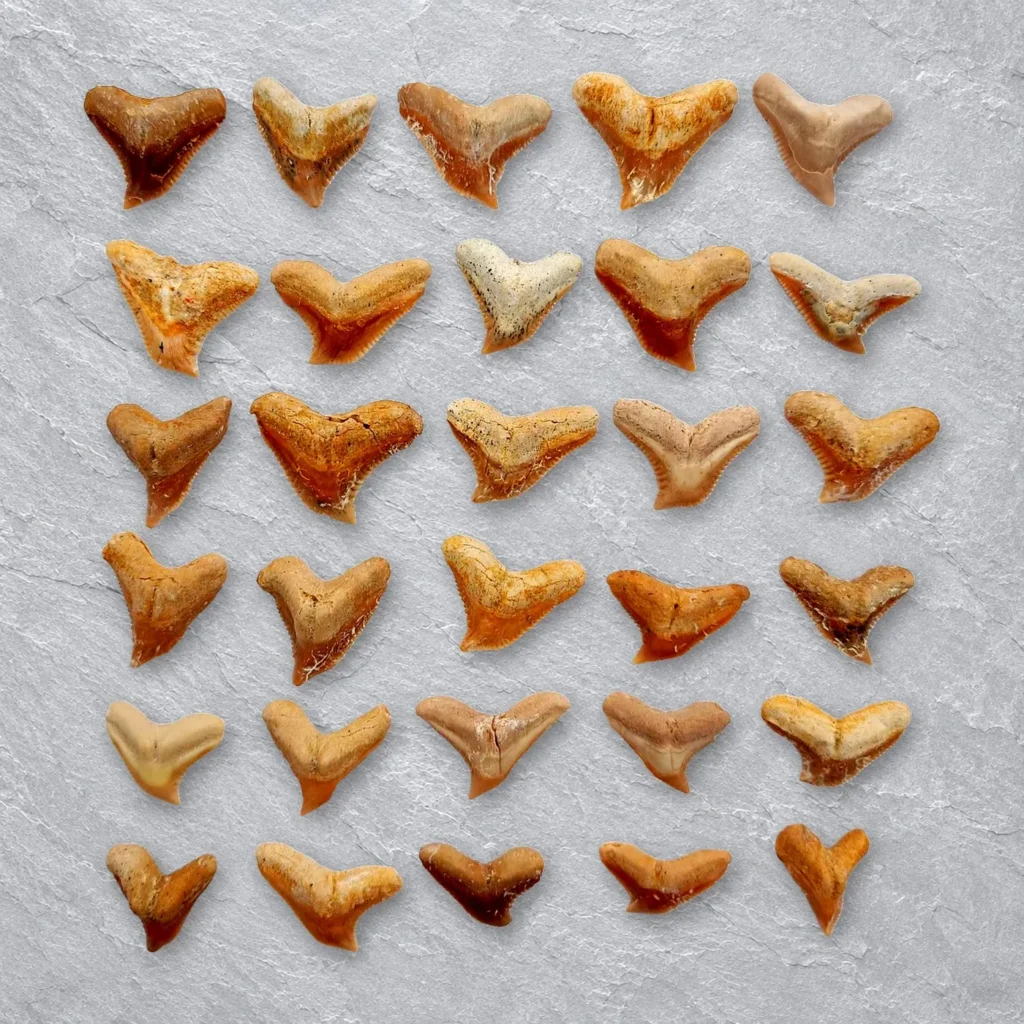
- Brachycarcharias: slightly broader, shorter-crowned teeth with small side cusplets. B. atlasi was named by Arambourg from the phosphates [1]; teeth of this species are known from the early Eocene of Morocco, and Ebersole and colleagues treat it as a valid species in their revision of Eocene fishes [3].
- Carcharias / Odontaspis type: teeth that cannot be pinned to a genus are often sold under these names. Strictly, both are modern genera; on fossil material they usually mean “sand tiger type”.
Key facts
| Scientific name | Odontaspididae: Striatolamia, Brachycarcharias and related genera |
|---|---|
| Order | Lamniformes |
| Geological age | mainly Paleocene to early Eocene (Ypresian) in Morocco |
| Formation | Moroccan phosphate series |
| Locality in Morocco | Oulad Abdoun Basin (Khouribga, Oulad Zem) |
| Typical size | about 1–4 cm (0.4–1.6 in) |
How to identify fossil sand tiger shark teeth
- Shape: a tall, narrow, often S-curved crown seen from the side. Lateral teeth are lower and broader.
- Cusplets: one or two small, needle-like cusplets on each side, frequently broken in lots; their absence does not make a tooth fake.
- Root: two long, slender lobes. Complete roots are a mark of quality.
- Striations: present in Striatolamia, absent in most other genera.
Small teeth of Cretolamna or young Otodus have broader crowns and triangular cusplets, which separates them from sand tigers.
How sand tigers fed
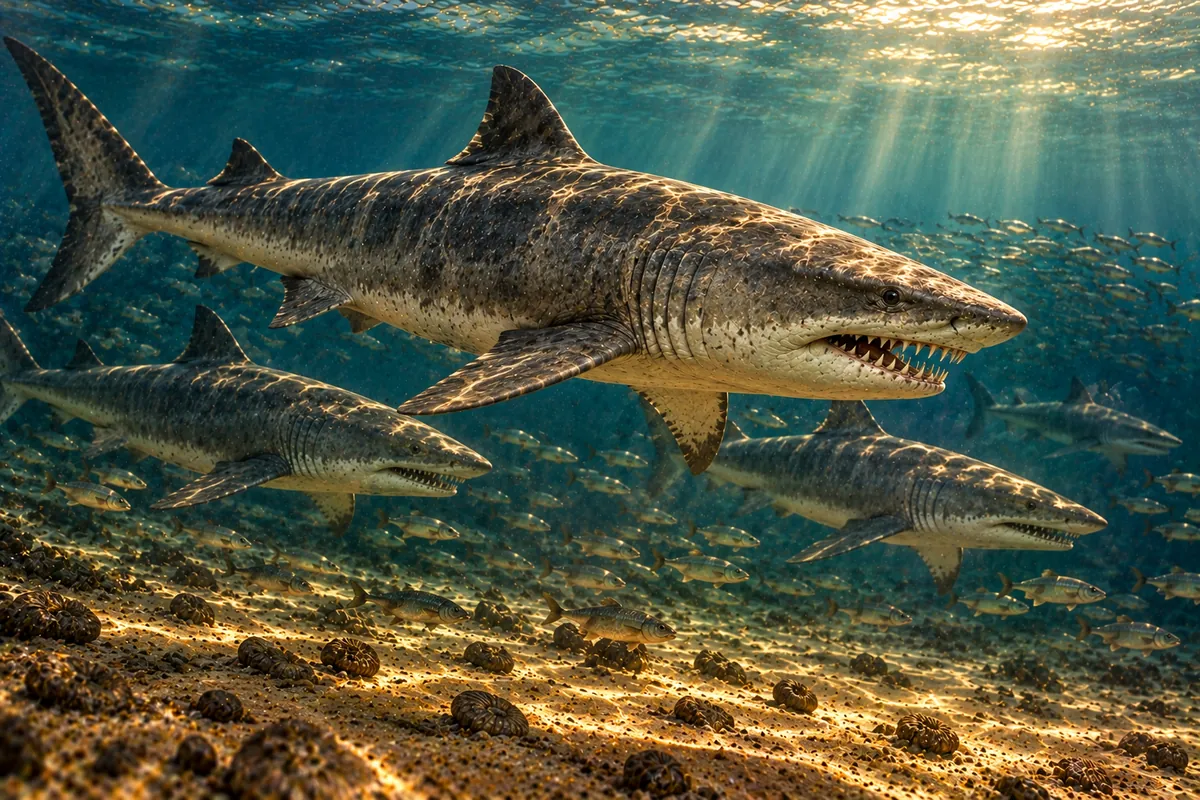
The long, narrow front teeth of odontaspidids are built to pierce and hold rather than slice. In living sand tigers the teeth protrude even when the mouth is closed, and prey such as fish and squid is usually swallowed whole. The fossil teeth show the same design, which is why so many fossil sand tiger shark teeth have needle-sharp tips but no serrations.
Grading fossil sand tiger shark teeth
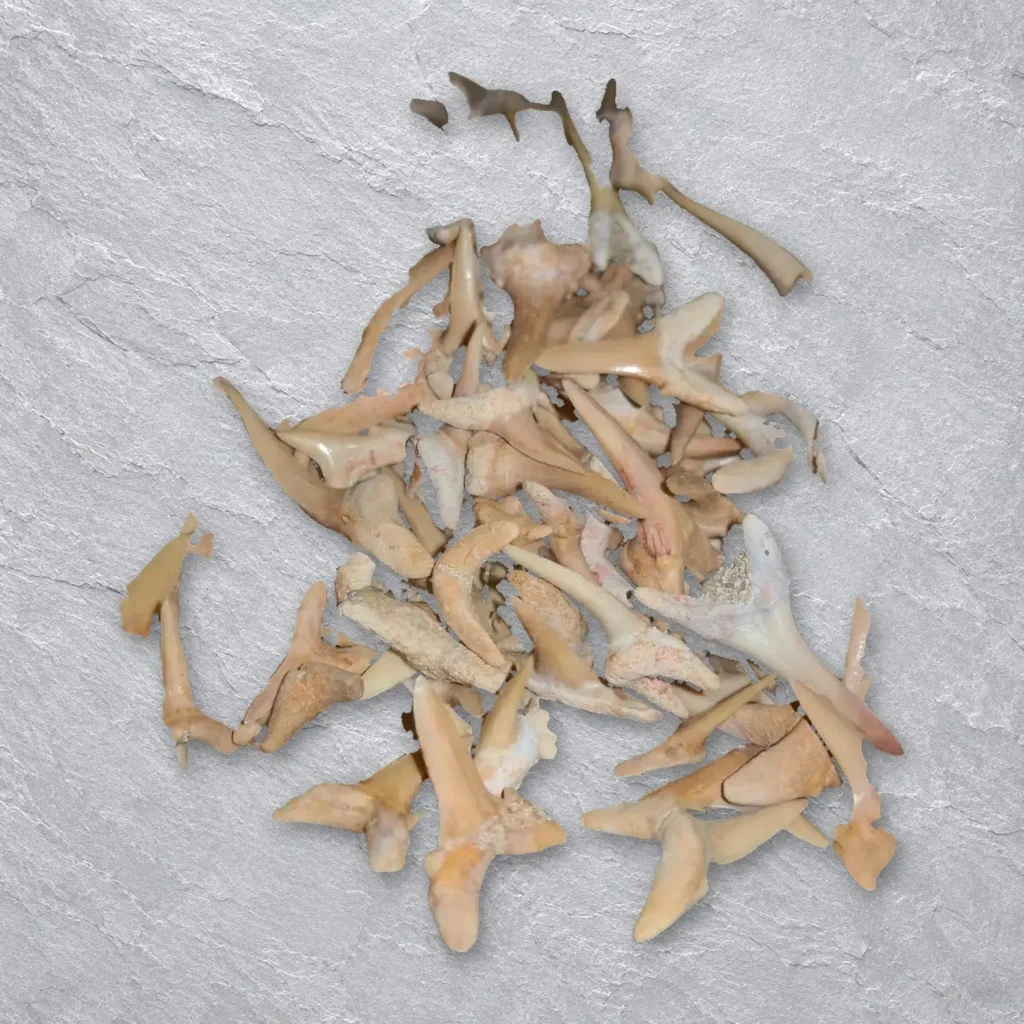
Wholesale grading usually combines three factors: length, completeness (tip, cusplets and both root lobes) and surface condition. A sensible shop mix contains a large share of small, inexpensive teeth for bins and kits, a middle grade for packaged sets, and a few large, complete anterior teeth as display pieces. Ask your supplier how lots are graded and whether each grade is counted or weighed.
The workhorse of wholesale shark teeth
Because they are abundant, fossil sand tiger shark teeth are the backbone of mixed shark-tooth lots, gift-shop bins, digging kits and classroom sets. Small teeth are normally sold by count or by weight; larger, complete teeth are graded and sold individually or in packs. Natural colors of fossil sand tiger shark teeth range from gray and blue-gray to tan.
Approved trade buyers see lot prices and tiered discounts after they apply for a wholesale account. For a custom mix of sizes or genera, request a quote. Rays and bony fish from the same beds are under fish fossils; return to all Moroccan shark teeth.
References
- Arambourg, C. (1952). Les vertébrés fossiles des gisements de phosphates (Maroc–Algérie–Tunisie). Notes et Mémoires du Service Géologique du Maroc 92: 1–372. shark-references.com bibliographic record
- Cappetta, H. (2012). Chondrichthyes: Mesozoic and Cenozoic Elasmobranchii: Teeth. Handbook of Paleoichthyology vol. 3E, 512 pp. Munich: Verlag Dr. Friedrich Pfeil. ISBN 978-3-89937-148-2. publisher page
- Ebersole, J. A., Cicimurri, D. J. & Stringer, G. L. (2019). Taxonomy and biostratigraphy of the elasmobranchs and bony fishes (Chondrichthyes and Osteichthyes) of the lower-to-middle Eocene (Ypresian to Bartonian) Claiborne Group in Alabama, USA, including an analysis of otoliths. European Journal of Taxonomy 585: 1–274. doi:10.5852/ejt.2019.585
Frequently asked questions
Are fossil sand tiger teeth the same species as the modern sand tiger?
No. The Moroccan teeth belong to extinct odontaspidid genera such as Striatolamia and Brachycarcharias. They share the long, narrow tooth shape of the living sand tiger, Carcharias taurus, because they fed in a similar way, but they are separate species that lived around 60 to 50 million years ago.
Why are sand tiger teeth so cheap compared to other fossil teeth?
They are extremely abundant. Phosphate mining around Khouribga produces large numbers of small teeth, and sand tigers are the most common group among them. Price rises sharply with size and completeness: a large tooth with intact root and cusplets is far scarcer than the small teeth used in mixed lots.
What is the best way to buy sand tiger teeth for a shop?
Most shops combine small teeth bought by count or weight for scoop bins with a smaller number of graded, larger teeth for display. Ask for size grades and whether lots are mixed genera. Approved wholesale accounts see our lot prices and quantity discounts, and custom mixes can be quoted.