
Why rays have tooth plates
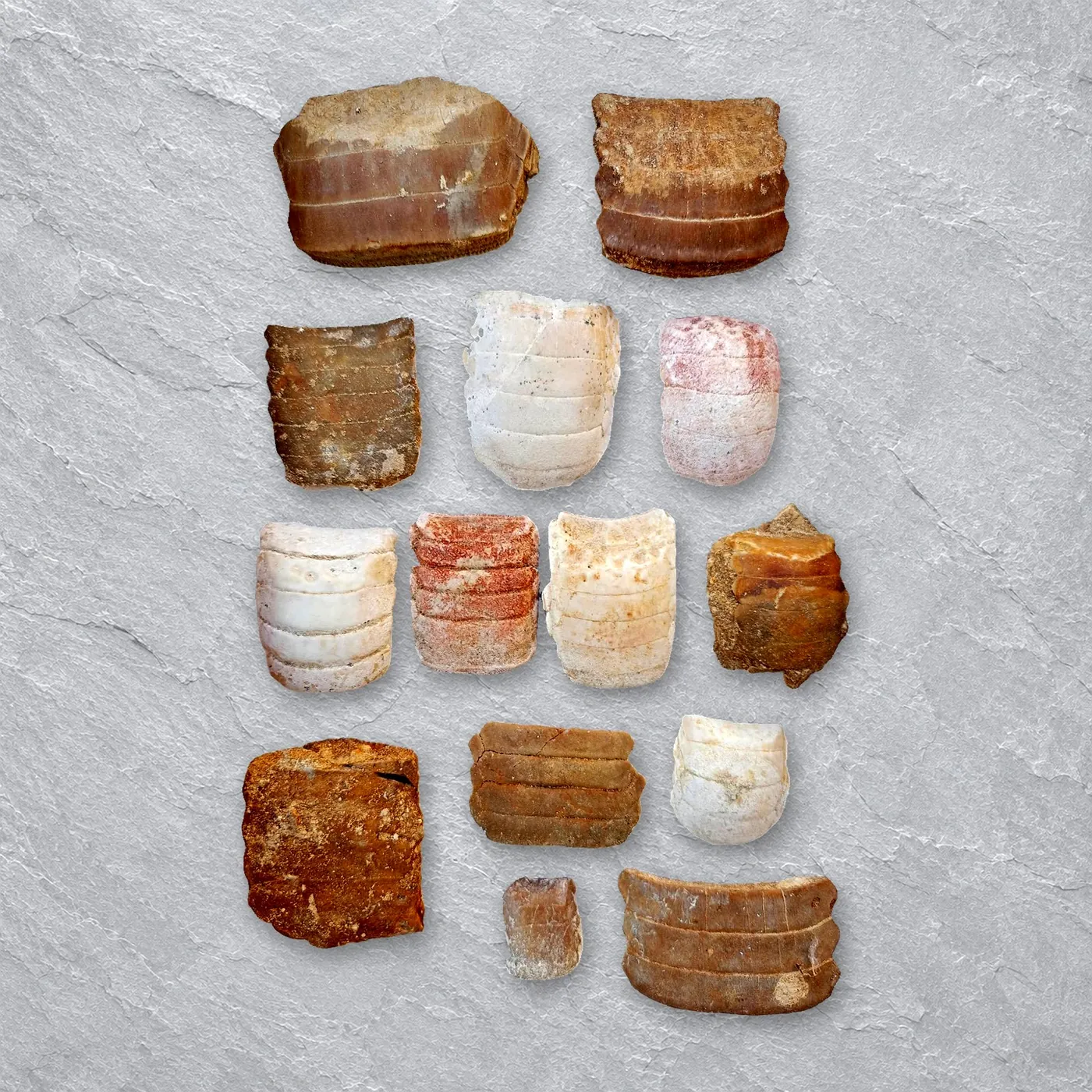
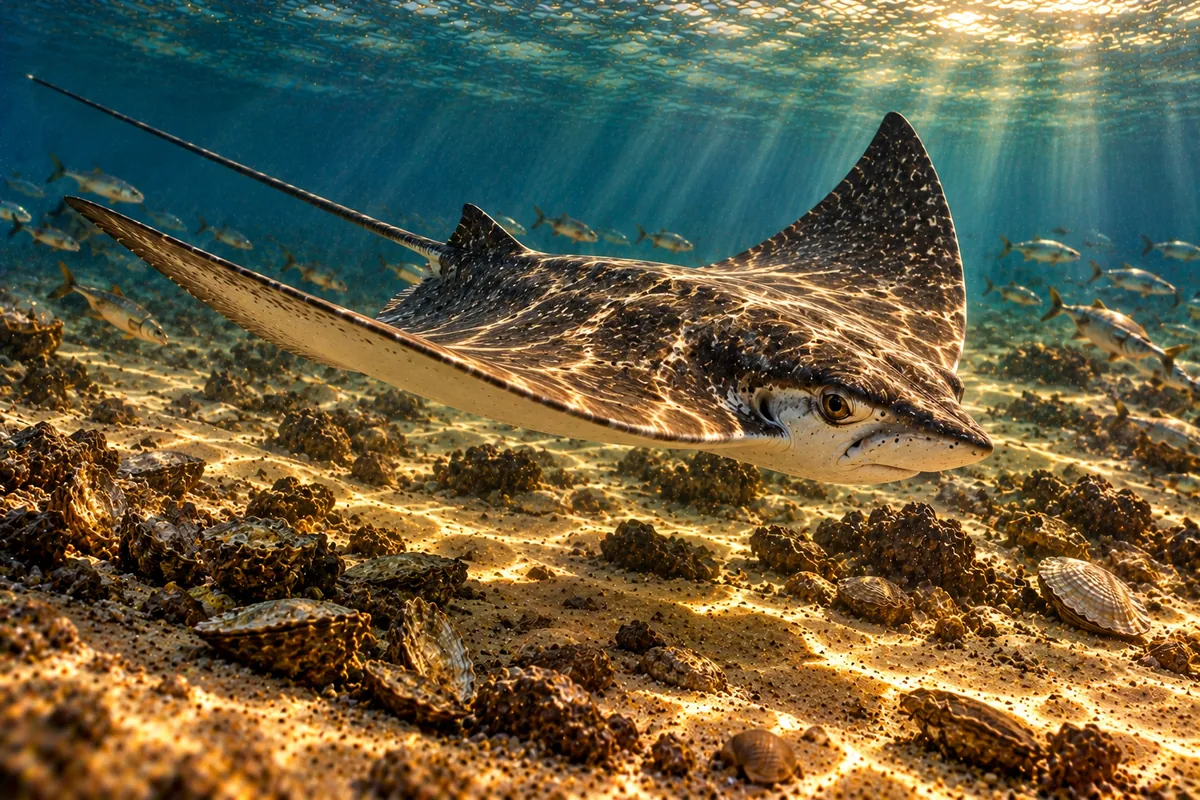
Many rays feed on hard-shelled prey: clams, oysters, snails and crabs. Instead of sharp teeth, they grow flat, interlocking teeth that form a pavement, a dental plate that works like a nutcracker. In eagle rays the plate is built from rows of hexagonal teeth; the wide central row dominates and is flanked by smaller lateral teeth. As old teeth wear at the front of the mouth, new rows move forward from the back.
Moroccan phosphate beds preserve these structures in two main forms: articulated plates of eagle rays, and isolated teeth of the extinct ray Rhombodus. Both belong to the Myliobatiformes, the stingrays and their relatives.
Myliobatis: eagle ray dental plates
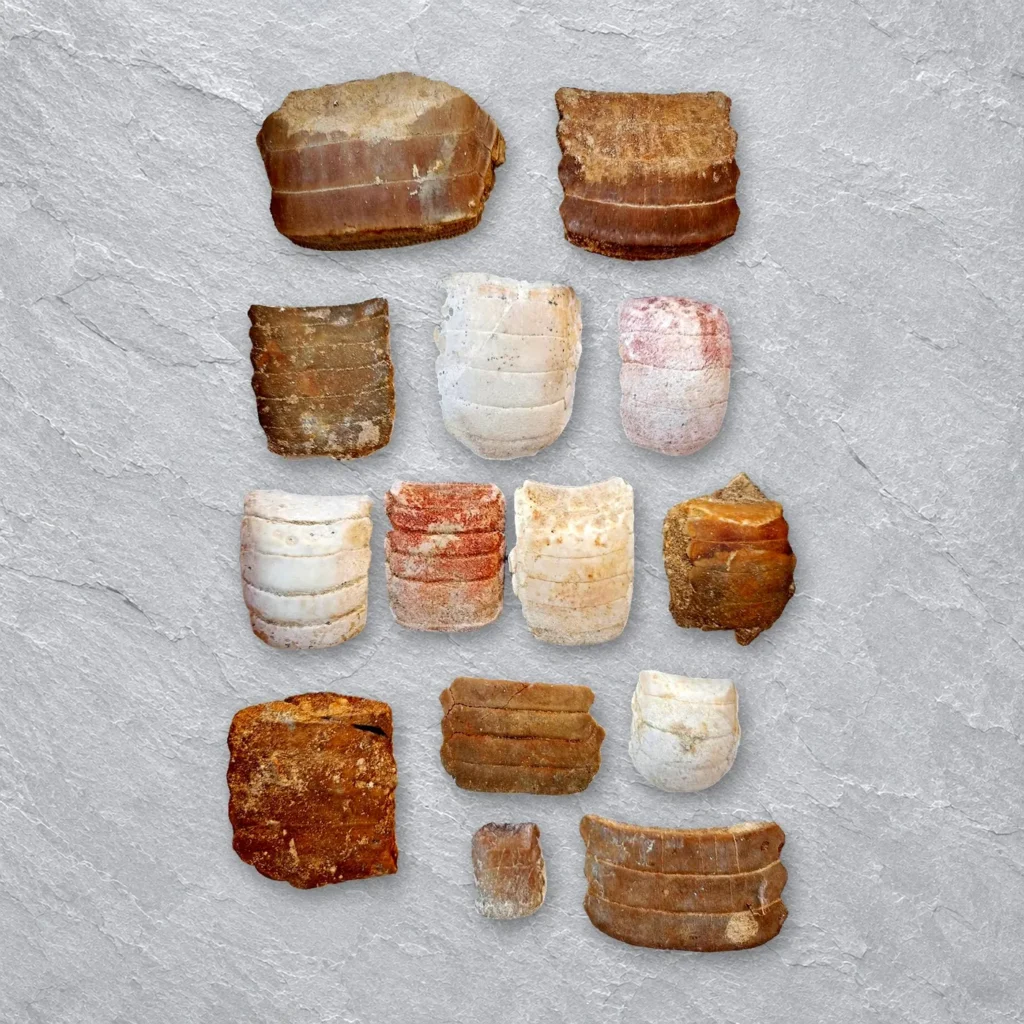
Fossil ray tooth plates from Khouribga are mostly eagle rays of the genus Myliobatis, from the Paleogene part of the phosphate series. Noubhani and Cappetta’s revision of the rays of the Moroccan phosphates, from the Maastrichtian to the basal Lutetian, remains the main scientific account of these faunas [1]. A complete plate shows several rows of central teeth joined side by side, with a ridged root on the underside. The flat, polished chewing surface shows wear from crushing shells.
Rhombodus: diamond-shaped teeth
Rhombodus teeth are single, rhomb-shaped crushing teeth rather than whole plates, and they come from the Maastrichtian, the latest Cretaceous. Noubhani and Cappetta revised the family Rhombodontidae from Moroccan phosphate material, describing a new species, R. andriesi, confirming R. binkhorsti and R. microdon as separate species, and moving R. bondoni, originally named by Arambourg [3], into the new genus Dasyrhombodus [2]. Because Rhombodus is characteristic of the Maastrichtian layers here, it is a useful age marker in mixed lots.
Key facts
| Scientific name | Myliobatis spp. (plates); Rhombodus spp. (isolated teeth) |
|---|---|
| Order | Myliobatiformes |
| Geological age | Maastrichtian (Rhombodus); Paleocene to early Eocene (Myliobatis) |
| Formation | Moroccan phosphate series |
| Locality in Morocco | Oulad Abdoun Basin, Khouribga area |
| Typical size | plates about 2–6 cm (0.8–2.4 in) wide; Rhombodus teeth about 0.5–1.5 cm |
How to judge a fossil ray tooth plate
- Number of rows: plates with more joined rows and intact lateral teeth are scarcer and display better.
- Root: the ridged root on the underside should be present; it is often partly broken.
- Check that row widths and wear match.
- Labels: mixed ray plates may include genera other than Myliobatis; identification follows Cappetta’s handbook [4], and “Myliobatidae indet.” is an honest label for worn plates.
From plate to single teeth
After death the soft tissue binding the teeth together decays, so a fossil ray tooth plate can be found complete, as a few joined rows, or as single central teeth. All three are genuine; complete plates with lateral teeth are simply the scarcest.
Each fossil ray tooth plate also carries a record of how the animal fed. Worn, polished surfaces at the front of the plate reflect crushing of shells in life, while the less worn rear rows had not yet come into use. Plates with this wear gradient are good teaching pieces.
Ray tooth plates for retail and wholesale
A fossil ray tooth plate is an easy item to explain at the counter: a ray’s “nutcracker” mouth from 55-million-year-old seas. Plates and Rhombodus teeth sell well in mixed fossil-tooth sets alongside sand tiger and Otodus teeth. Approved trade buyers see lot prices and tiered discounts after they apply for a wholesale account; for custom quantities, request a quote. See all Moroccan fish fossils.
References
- Noubhani, A. & Cappetta, H. (1997). Les Orectolobiformes, Carcharhiniformes et Myliobatiformes (Elasmobranchii, Neoselachii) des Bassins à phosphate du Maroc (Maastrichtien–Lutétien basal). Systématique, biostratigraphie, évolution et dynamique des faunes. Palaeo Ichthyologica 8: 1–327. shark-references.com bibliographic record
- Noubhani, A. & Cappetta, H. (1994). Révision des Rhombodontidae (Neoselachii, Batomorphii) des bassins à phosphate du Maroc. PalaeoVertebrata 23(1–4): 1–49. doi:10.18563/pv.23.1-4.1-49
- Arambourg, C. (1952). Les vertébrés fossiles des gisements de phosphates (Maroc–Algérie–Tunisie). Notes et Mémoires du Service Géologique du Maroc 92: 1–372. shark-references.com bibliographic record
- Cappetta, H. (2012). Chondrichthyes: Mesozoic and Cenozoic Elasmobranchii: Teeth. Handbook of Paleoichthyology vol. 3E, 512 pp. Munich: Verlag Dr. Friedrich Pfeil. ISBN 978-3-89937-148-2. publisher page
Frequently asked questions
What is a ray tooth plate?
It is a set of flat, interlocking teeth fused into a pavement that rays use to crush shellfish such as clams and crabs. In eagle rays like Myliobatis the plate is made of rows of hexagonal teeth, with new rows moving forward to replace worn ones. Fossil plates preserve this structure in mineralized form.
How old are Moroccan ray tooth plates?
Myliobatis plates come from the Paleocene to early Eocene levels of the Khouribga phosphates, roughly 60 to 50 million years old. Rhombodus teeth are older, from the Maastrichtian at the end of the Cretaceous, about 72 to 66 million years old. Each listing states the age of the bed it comes from.
What is the difference between Myliobatis and Rhombodus?
Myliobatis is an eagle ray genus whose teeth form joined plates of hexagonal rows; it still lives today. Rhombodus is an extinct Cretaceous ray known mainly from single, diamond-shaped crushing teeth. In Morocco, Rhombodus is characteristic of the Maastrichtian layers, while Myliobatis plates come from younger Paleogene beds.