
Two very different fish faunas
Moroccan fish fossils come mainly from two settings, separated by more than 20 million years and hundreds of kilometers.
The Kem Kem Group of southeastern Morocco is a set of Cenomanian river and delta deposits, made up of the Gara Sbaa and Douira formations. Its fossils are mostly isolated remains of cartilaginous and bony fishes, turtles, crocodyliforms, pterosaurs and dinosaurs such as Spinosaurus [2]. Fish remains include sawfish-like rostral denticles and lungfish tooth plates.
The phosphate basins around Khouribga are marine and younger, from the Maastrichtian to the early Eocene. Many of their bony fish and rays were first described in Arambourg’s monograph on the North African phosphates [1], and they occur alongside the shark teeth sold in the largest volumes.
Groups in this category
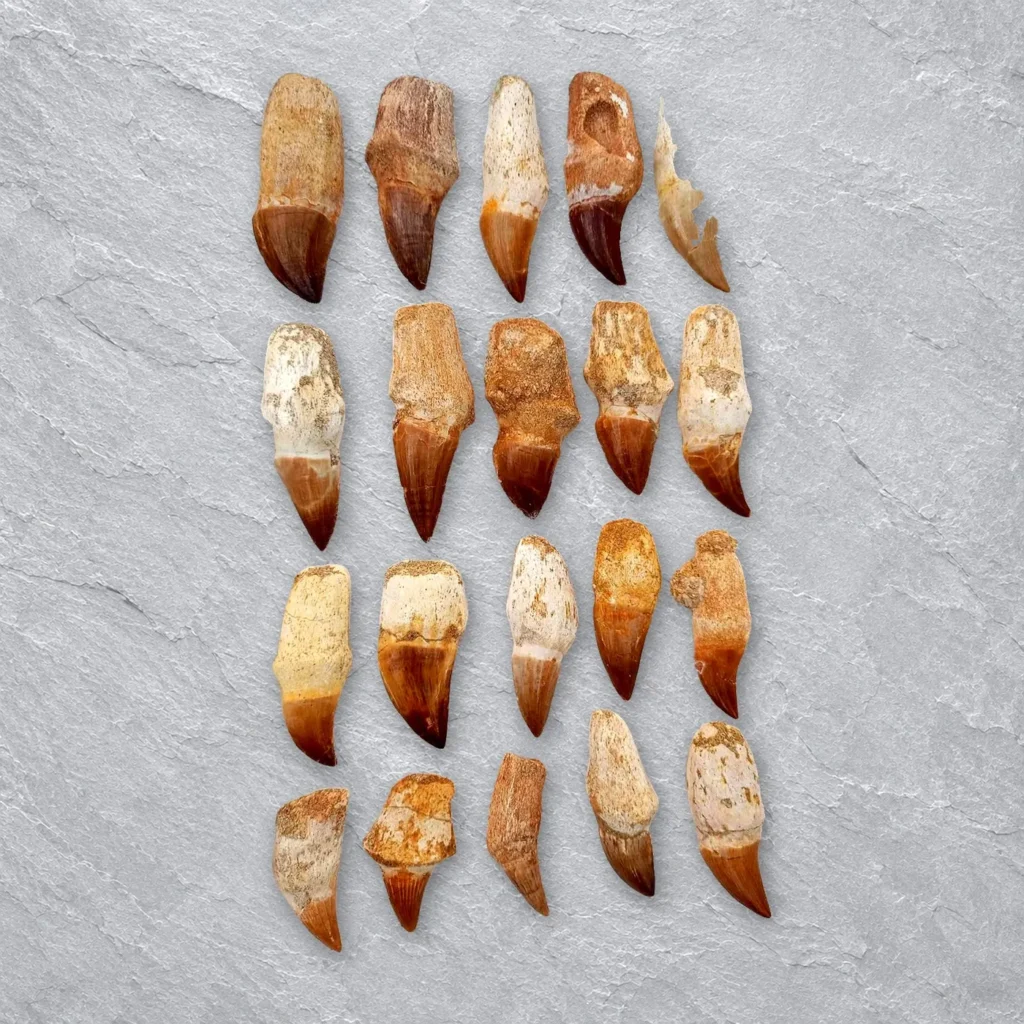
- Enchodus teeth: long, curved fangs of a Cretaceous predatory bony fish nicknamed the “saber-toothed herring”, from the Maastrichtian phosphates.
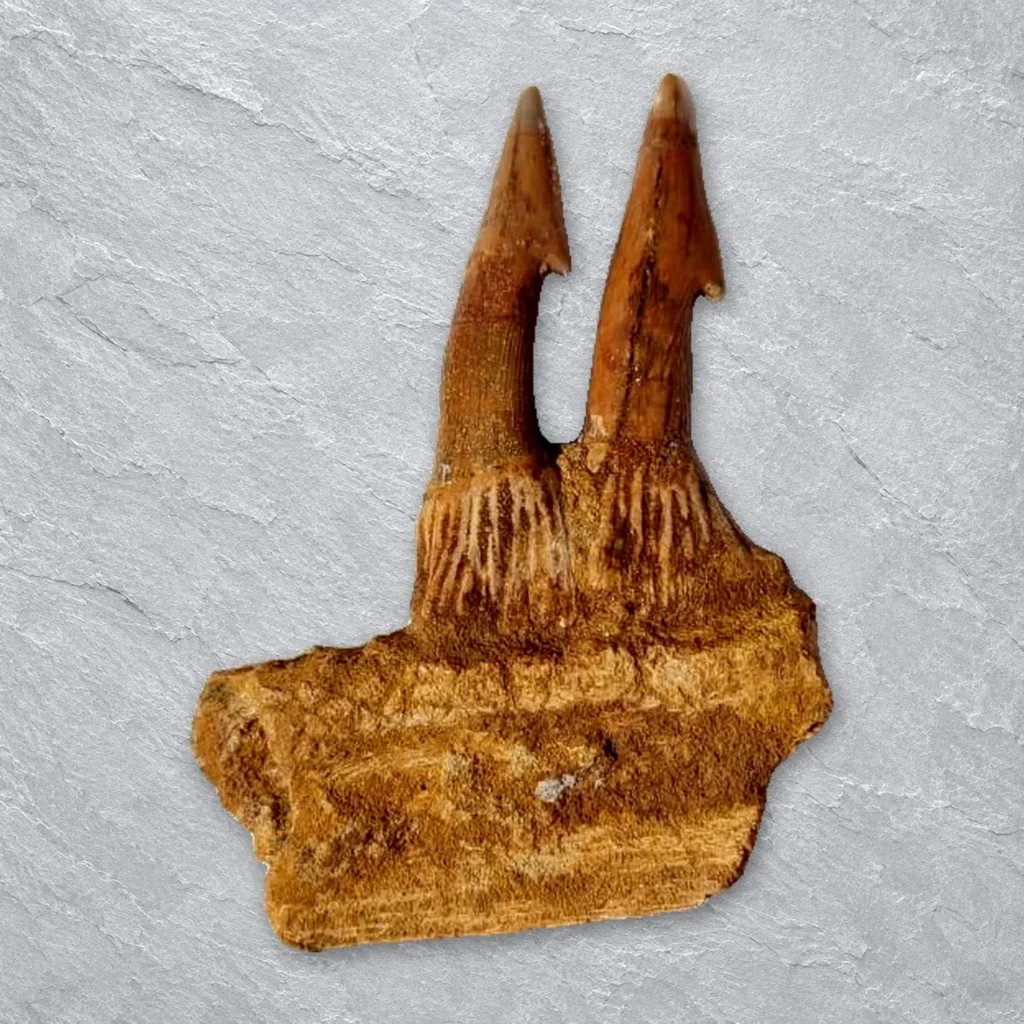
- Onchopristis sawfish teeth: barbed rostral denticles of a giant sawfish-like ray from the Kem Kem beds. Its skeleton and probable tolerance of both fresh and salt water were described in 2021 [4].
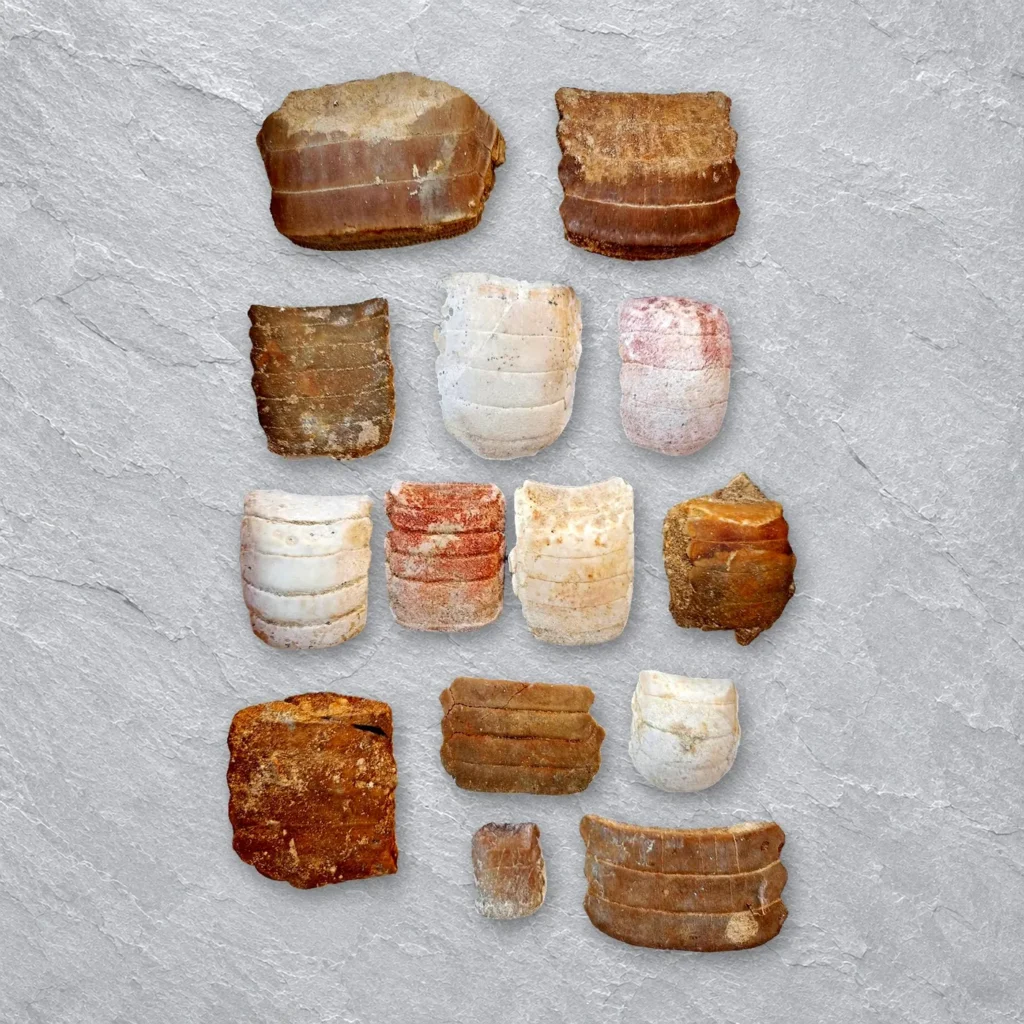
- Ray tooth plates: the crushing dental plates of eagle rays (Myliobatis) and the diamond-shaped teeth of Rhombodus, a ray genus revised from Moroccan phosphate material [3].
Key facts
| Scientific groups | Bony fishes (Enchodus), sclerorhynchoid rays (Onchopristis), myliobatiform rays (Myliobatis, Rhombodus) |
|---|---|
| Geological age | Cenomanian (Kem Kem); Maastrichtian to early Eocene (phosphates) |
| Formation | Kem Kem Group; Moroccan phosphate series |
| Locality in Morocco | Taouz and Begaa area (Kem Kem); Oulad Abdoun Basin, Khouribga (phosphates) |
| Typical size | about 1–8 cm (0.4–3 in) per specimen |
Why Moroccan fish fossils are mostly teeth
Complete fish skeletons are rare in both settings. Rivers and phosphate-rich sea floors sorted and reworked bones, and only the hardest parts survived in large numbers: teeth, fangs, rostral denticles and tooth plates. That is why most Moroccan fish fossils on the market are isolated hard parts. They are less spectacular than a whole fish on a slab, but they are abundant, affordable and scientifically meaningful, since many fish genera were described from exactly these elements. The Kem Kem beds also produce lungfish tooth plates, preserved in the same river sediments [2].
Buying Moroccan fish fossils
Fish teeth and plates are strong add-on lines for shops already selling Moroccan shark teeth and dinosaur fossils: inexpensive, easy to display, and each with a clear story. Points to check:
- Locality and age. Kem Kem and Khouribga material differ by more than 20 million years and by environment; a label should say which.
- Repairs. Long Enchodus fangs and Onchopristis denticles often break and are glued. Our listings say natural, repaired or restored.
- Matrix pieces. Fangs “in rock” may be natural or set into matrix. Ask which.
Approved trade buyers see lot prices and quantity discounts after they apply for a wholesale account. For mixed orders, request a quote.
References
- Arambourg, C. (1952). Les vertébrés fossiles des gisements de phosphates (Maroc–Algérie–Tunisie). Notes et Mémoires du Service Géologique du Maroc 92: 1–372. shark-references.com bibliographic record
- Ibrahim, N., Sereno, P. C., Varricchio, D. J., Martill, D. M., Dutheil, D. B., Unwin, D. M., Baidder, L., Larsson, H. C. E., Zouhri, S. & Kaoukaya, A. (2020). Geology and paleontology of the Upper Cretaceous Kem Kem Group of eastern Morocco. ZooKeys 928: 1–216. doi:10.3897/zookeys.928.47517
- Noubhani, A. & Cappetta, H. (1994). Révision des Rhombodontidae (Neoselachii, Batomorphii) des bassins à phosphate du Maroc. PalaeoVertebrata 23(1–4): 1–49. doi:10.18563/pv.23.1-4.1-49
- Villalobos-Segura, E., Kriwet, J., Vullo, R., Stumpf, S., Ward, D. J. & Underwood, C. J. (2021). The skeletal remains of the euryhaline sclerorhynchoid †Onchopristis (Elasmobranchii) from the ‘Mid’-Cretaceous and their palaeontological implications. Zoological Journal of the Linnean Society 193(2): 746–771. doi:10.1093/zoolinnean/zlaa166
Frequently asked questions
Where do Moroccan fish fossils come from?
Mainly from two areas. The Kem Kem Group in the southeast, near Taouz and Begaa, is a Cenomanian river and delta system about 100 to 94 million years old. The phosphate basins around Khouribga are marine sediments from the Maastrichtian to the early Eocene, roughly 72 to 48 million years old, and supply most fish teeth and ray plates.
Are fish teeth and ray plates real fossils or casts?
They are real, mineralized fossils. Teeth and dental plates are made of hard phosphatic tissue, which is why they survive in such numbers. Casts are uncommon for these inexpensive items, but repairs on long fangs and denticles are common. Our listings state natural, repaired or restored for each piece.
Can I buy fish fossils in bulk for my shop?
Yes. Enchodus fangs, ray tooth plates and smaller Onchopristis denticles are available as graded wholesale lots for approved trade accounts, with tiered quantity discounts. Apply for a wholesale account to see lot prices, or request a quote for a custom mix with shark teeth or other Moroccan fossils.