
What a geode is
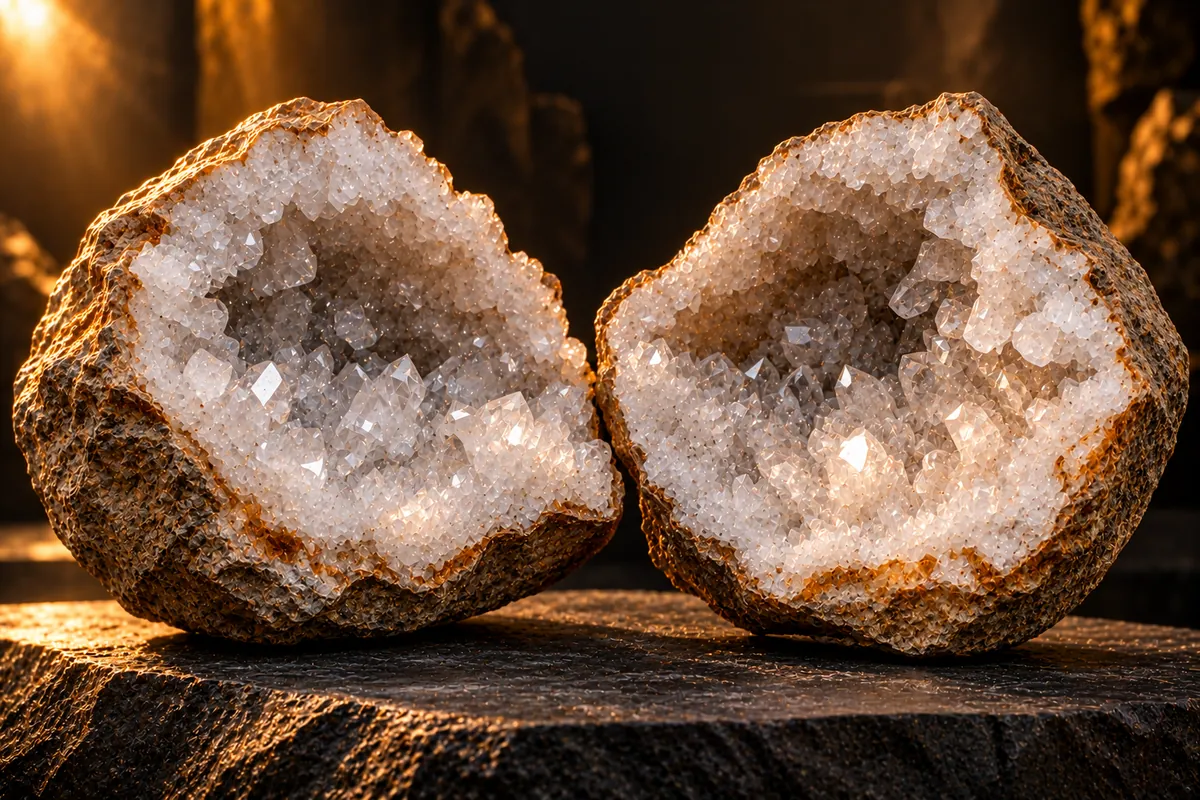
A geode is a hollow, roughly spherical rock body whose cavity is lined with crystals growing inward toward the center. The outer shell is usually a dense layer of chalcedony (microcrystalline quartz) or of the host rock itself. Inside, the most common lining in Moroccan geodes is clear to white quartz, SiO2; calcite, CaCO3, forms the softer, often golden or white rhombic crystals in some pieces. If the cavity fills completely, the result is a solid nodule rather than a geode.
| Chemical formula | Quartz SiO2; calcite CaCO3 |
|---|---|
| Crystal system | Trigonal (both) |
| Mohs hardness | Quartz 7; calcite 3 |
| Moroccan locality | Morocco (specific locality stated per listing) |
| Typical habit | Rounded nodules, opened to show inward-pointing crystal linings |
How geodes form
Geodes form in two main geological settings, and the process matters for what the inside looks like.
In sedimentary rock
Many geodes start as nodules of a different mineral that is later replaced. In a classic study of quartz geodes in Mississippian dolostones of Tennessee, Chowns and Elkins showed that the geodes are pseudomorphs after early anhydrite nodules: the anhydrite grew in arid tidal-flat sediments much like modern Persian Gulf sabkhas, and silica later replaced it from the outside inward, leaving a quartz rind and, where replacement was incomplete, a cavity that crystals then lined[1]. Such geodes often have a knobby, cauliflower-like exterior.
In volcanic rock
In lava flows, gas bubbles (vesicles) leave cavities. Over long periods, silica-rich groundwater deposits banded agate and then quartz crystals inside them. Morocco has volcanic sources of this kind: around Kerrouchen in Khénifra Province, agates occur in Triassic to Early Jurassic basalts, and Mindat records quartz, chalcedony and hematite there[2].
In both cases crystal growth is slow and happens from the wall inward, which is why the crystals point toward the center and why larger cavities can hold larger crystals.
What to expect from Moroccan geodes
Moroccan geodes in the trade are typically rounded nodules with a light, often knobby exterior and a white to clear quartz lining, sold whole or already opened. Because each geode formed independently, no two linings are identical: some show large sparkling points, others fine druzy crystals or banded chalcedony edges. For that reason, Moroccan geodes are graded by size and overall cavity quality rather than by identical appearance.
Choosing Moroccan geodes for a shop
- Opened or whole: opened halves show their contents immediately and sell on looks. Whole “crack your own” geodes sell on the experience; customers like opening them with a hammer and safety glasses.
- Cavity quality: look for a clean, sparkling lining with few crushed crystals and a well-defined rim.
- Size grading: flats of uniform size make pricing and display easy. Check the size range and count on each flat listing.
- Pairs: two matching halves are worth more than two odd halves.
Dyed, glued and polished geodes
Bright pink, blue or purple geodes and agate slices are almost always dyed. Dye collects in cracks and in the porous chalcedony layer and looks too uniform across a batch. Some geodes are also cut and polished on the rim, or broken halves are glued back together; check the seam. Polishing is a legitimate finish but should be stated. Our listings say whether a geode is natural, dyed or repaired.
Care
Quartz-lined Moroccan geodes are durable: rinse with lukewarm water and a soft brush, then dry. Calcite-lined geodes are softer and react to acid, so never use vinegar or household cleaners on them. Keep any glued geode dry.
Wholesale geode flats
Moroccan geodes are a dependable volume line. Apply for a wholesale account to see lot pricing and tiered quantity discounts, or use Request a Quote for large or mixed orders. Geodes pair well with Moroccan amethyst and desert roses; return to Stones & Rocks for the full range.
References
- Chowns, T.M., & Elkins, J.E. (1974). The origin of quartz geodes and cauliflower cherts through the silicification of anhydrite nodules. Journal of Sedimentary Petrology 44(3): 885 ff. archives.datapages.com
- Mindat.org, Hudson Institute of Mineralogy (n.d.). Kerrouchene (Kerrouchen), Khénifra Province, Béni Mellal-Khénifra Region, Morocco. Mindat locality database. Accessed 29 October 2026. mindat.org/loc-108596
Frequently asked questions
How are geodes formed?
Geodes begin as cavities in rock, either gas bubbles in volcanic lava or nodules of another mineral, such as anhydrite, in sedimentary rock that are later replaced by silica. Mineral-rich groundwater then deposits chalcedony and quartz or calcite crystals on the walls, growing inward. If the cavity fills completely, it becomes a solid nodule.
How do I open a whole geode?
Wear safety glasses. Place the geode in a sock or cloth bag, then strike the middle firmly with a hammer, or score it around the circumference with a chisel before striking. Shops sometimes use a pipe cutter-style geode cracker for cleaner halves. Results vary, which is part of the fun for customers.
Are colorful geodes natural?
Natural Moroccan quartz geodes are white to clear, sometimes with cream, gray or brownish outer shells. Vivid pink, blue, green or purple geodes are almost always dyed. Dye tends to pool in cracks and the porous chalcedony layer. We state on each listing whether geodes are natural or dyed.
What is the difference between quartz and calcite geodes?
Quartz linings are hard (Mohs 7), glassy and pointed, and they do not react to acid. Calcite linings are softer (Mohs 3), often show rhombic or dogtooth crystals, and fizz with weak acid. Clean calcite geodes only with water and a soft brush, never with vinegar or cleaners.