
What a desert rose is
A desert rose stone, also called a sand rose, is a cluster of flattened crystals arranged in radiating, petal-like groups. The crystals are usually gypsum (CaSO4·2H2O) and sometimes barite (BaSO4). Because they grow inside loose sand rather than in an open cavity, each blade encloses abundant sand grains, which gives the rose its color, matte texture and gritty surface. Iron oxide coatings add rusty tones.
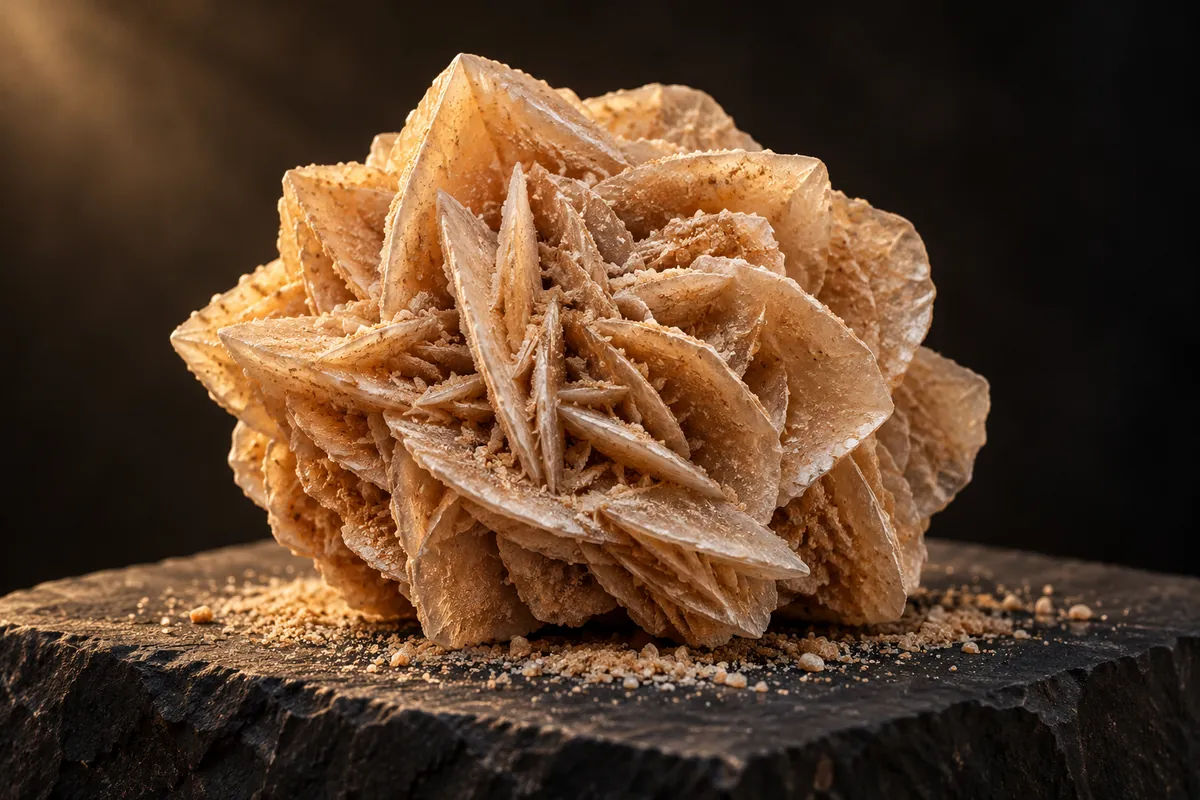
| Chemical formula | Gypsum CaSO4·2H2O (most roses); barite BaSO4 |
|---|---|
| Crystal system | Gypsum monoclinic; barite orthorhombic |
| Mohs hardness | Gypsum 2; barite 3–3.5 |
| Moroccan locality | Saharan sands; specific locality stated per listing |
| Typical habit | Radiating rosettes of thin bladed crystals enclosing sand grains |
How a desert rose stone forms
Desert roses form in arid environments where groundwater carrying dissolved calcium and sulfate sits close beneath sand. As water evaporates through the sand toward the surface, it becomes supersaturated and gypsum crystallizes between the grains. The crystals grow as flat blades and fan out in all directions, trapping sand as they go.
A study of modern sand roses in coastal sabkhas of eastern Saudi Arabia describes the process in detail. Gypsum typically made up more than 20% of the rose volume, with some converted to anhydrite. Gypsum cement increased from the water table upward toward the sabkha surface, and roses grew larger and lighter in color farther from the water table. Once exposed at the surface, the roses acquired an iron oxide cement[1]. The same basic process operates in interdune flats and salt basins across the Sahara.
Barite roses
Barite roses form in a similar shape by a different chemistry. The best-studied examples, the “rose rocks” of Oklahoma, are radiating sprays of disc-shaped barite crystals that enclose quartz sand from the Permian Garber Sandstone, with a little hematite giving them their reddish color[2]. Barite roses are heavier and typically less sharp-edged than gypsum roses.
For a shop, the formation story is the selling point: each desert rose stone records a shallow water table in a desert, with sand grains locked inside the crystals as they grew. A short label explaining that process, and naming the mineral as gypsum or barite, adds value at no cost.
Gypsum or barite: a quick check
- Weight: barite roses feel noticeably heavy for their size.
- Edges: gypsum roses usually have thinner, sharper blades.
- Hardness: gypsum can be scratched with a fingernail; barite cannot.
Choosing desert rose stones for resale
Look for full, symmetrical rosettes with many well-defined petals, intact edges and stable bases. Clusters with several roses grown together make strong display pieces, while small single roses suit flats and impulse sales. Expect natural variation in color, from pale sand to rusty orange.
Glue and repairs
Every desert rose stone is fragile. Broken petals are sometimes reattached, and some “clusters” are assembled from separate roses. Look at the junctions: natural intergrowth shows continuous sand texture, while glue leaves a shiny line or a gap. Our listings state whether each piece is natural or repaired.
Care
Gypsum is very soft and slightly soluble in water. Never wash a gypsum desert rose stone; dust it with a soft dry brush or compressed air. Keep it out of damp bathrooms and outdoor displays, and handle it by the base. Barite roses are tougher but should still be kept dry.
Wholesale desert roses
The desert rose stone is an affordable, high-turnover line. Apply for a wholesale account for lot pricing and tiered quantity discounts, or use Request a Quote for large orders. They pair naturally with selenite, another form of gypsum; browse more in Stones & Rocks.
References
- Al-Hussaini, A., Koeshidayatullah, A., & Al-Ramadan, K. (2015). Formation conditions and diagenetic evolution of sand roses in clastic sabkhas along the Arabian Gulf coastal region, eastern Saudi Arabia. Geological Quarterly 59(1): 71–78. doi:10.7306/gq.1207
- London, D. (2009). The Barite Roses of Oklahoma. Oklahoma Geological Survey Information Series 13. Norman: Oklahoma Geological Survey. ou.edu/ogs
Frequently asked questions
How does a desert rose form?
A desert rose forms when groundwater rich in calcium and sulfate evaporates through sand close to the surface. Gypsum crystallizes between the sand grains as thin blades that radiate outward, trapping sand inside. Barite roses form similarly where barium and sulfate meet in groundwater. Growth takes place in arid settings such as sabkhas and interdune flats.
Can I wash a desert rose stone?
No. Most desert roses are gypsum, which is very soft (Mohs 2) and slightly soluble in water. Washing can dissolve fine edges and loosen sand. Clean with a soft, dry brush or a gentle blast of compressed air, and keep the piece in a dry room.
What is the difference between a gypsum rose and a barite rose?
Both have the same rosette shape, but barite roses are much heavier for their size and harder, while gypsum roses are lighter, softer and usually have thinner, sharper blades. Gypsum can be scratched with a fingernail; barite cannot. The best-known barite roses are the rose rocks of Oklahoma.
Are desert roses ever glued together?
Sometimes. Because they break easily, petals may be reattached and separate roses may be combined into clusters. Check junctions for shiny glue lines or gaps instead of continuous sandy texture. Our listings state whether each desert rose is natural or repaired.