
Selenite is gypsum
Selenite is the transparent, well-crystallized variety of gypsum, hydrated calcium sulfate, CaSO4·2H2O. Gypsum defines hardness 2 on the Mohs scale, so it scratches with a fingernail. It has one perfect cleavage that splits into thin, flexible sheets with a pearly to glassy luster. The name comes from the Greek for “moon,” a reference to that soft glow.
Gypsum crystallizes from water rich in calcium and sulfate, commonly as seawater or lake water evaporates. Laboratory work shows that its formation can pass through a nanocrystalline precursor, bassanite, before becoming gypsum[1]. Under exceptionally stable conditions gypsum can grow enormous: the selenite crystals of the Naica mine in Mexico reach about 11 m, grown slowly from low-salinity water at around 54 °C[2].
| Chemical formula | CaSO4·2H2O |
|---|---|
| Crystal system | Monoclinic |
| Mohs hardness | 2 |
| Moroccan locality | Morocco (specific locality stated per listing) |
| Typical habit | Transparent tabular crystals and cleavage sheets; fibrous satin spar in veins |
Selenite or satin spar?
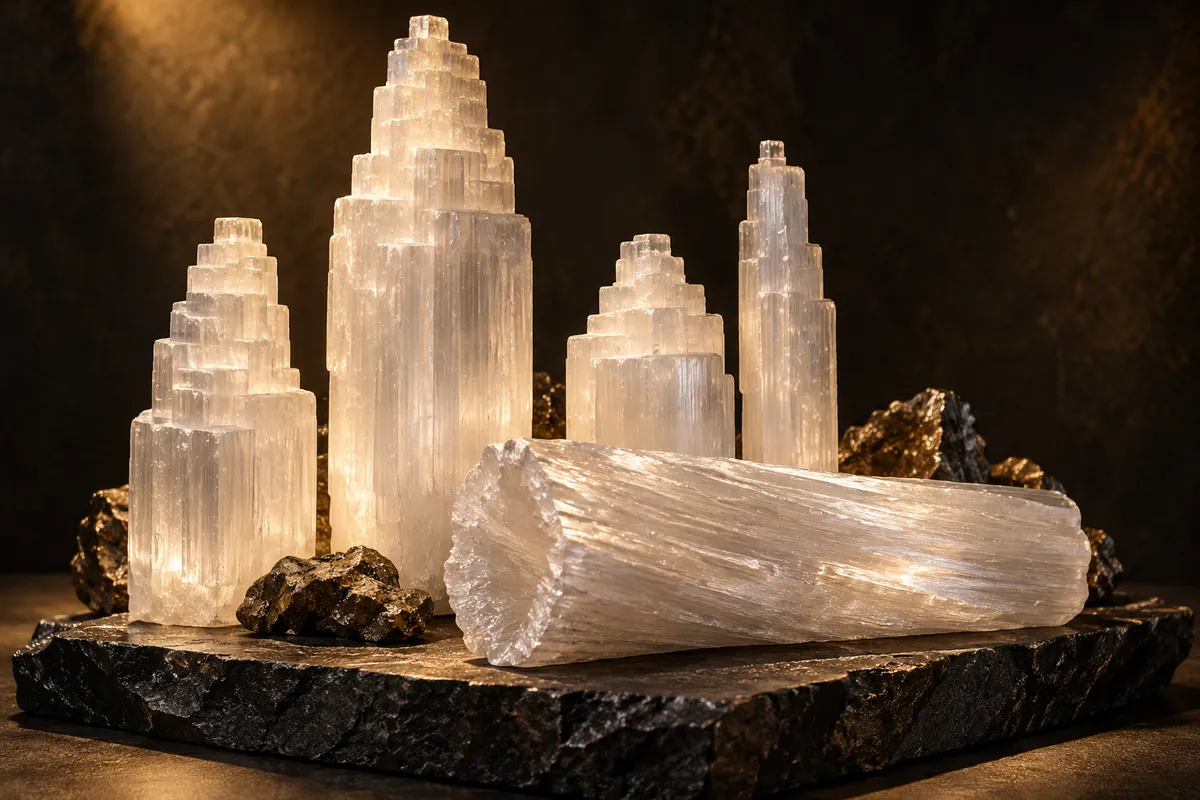
Most “selenite” towers, logs, wands and lamps on the market are cut from satin spar, a fibrous form of gypsum that grows in parallel fibers inside rock veins. Satin spar shows a silky, chatoyant sheen that moves as you turn it, and its fibers run along the length of the piece. True selenite is clear and glassy and splits into flat, see-through sheets. Both are gypsum, and both are legitimate products, but they are different materials, and buyers of wholesale selenite increasingly ask. We name each product correctly.
Wholesale selenite products in this category
- Raw crystals and plates: natural transparent selenite, sold by weight or piece.
- Towers and wands: cut and polished points, usually satin spar.
- Logs and sticks: lightly worked natural sections showing the fibrous structure.
- Lamps and bowls: carved pieces fitted with a bulb or used as decor.
Water sensitivity: the essential care rule
Gypsum is slightly soluble in water, roughly two grams per liter at room temperature. That sounds small, but repeated wiping with a wet cloth, a rinse under the tap or a humid bathroom will round edges, dull polish and leave a chalky surface. Practical rules:
- Never wash, soak or put selenite in water, and never place it outdoors.
- Clean with a dry, soft cloth or brush only.
- Store and display in dry rooms; avoid kitchens and bathrooms.
- Handle lamps and towers by the base; edges chip easily.
- Pack individually with soft wrap; selenite scratches against harder stones.
If you buy wholesale selenite, pass these tips on to customers; it reduces returns and builds trust.
Packing and shipping
Wholesale selenite is light for its volume but scratches and chips easily, so packing decides how much of an order arrives sellable. Individual wrapping for towers and lamps, rigid dividers for logs, and dry, sealed cartons are the safest approach. On arrival, unpack in a dry room and check edges before stocking shelves.
Dyed and treated selenite
Colored selenite and satin spar (orange, pink, blue) is usually dyed or coated. Natural material is white to colorless, sometimes with faint peach or brown tones from impurities. Dye tends to collect along fibers and in cracks. Our wholesale selenite listings state whether a product is natural, dyed or repaired.
Wholesale selenite orders
Selenite is light in price but bulky and fragile, so careful packing matters as much as price. Apply for a wholesale account to see lot pricing and tiered quantity discounts, or use Request a Quote for mixed or large orders. Pair selenite with desert roses, another gypsum product, or browse all Stones & Rocks.
References
- Van Driessche, A.E.S., Benning, L.G., Rodriguez-Blanco, J.D., Ossorio, M., Bots, P., & García-Ruiz, J.M. (2012). The role and implications of bassanite as a stable precursor phase to gypsum precipitation. Science 336(6077): 69–72. doi:10.1126/science.1215648
- García-Ruiz, J.M., Villasuso, R., Ayora, C., Canals, A., & Otálora, F. (2007). Formation of natural gypsum megacrystals in Naica, Mexico. Geology 35(4): 327–330. doi:10.1130/G23393A.1
Frequently asked questions
Is selenite the same as satin spar?
Both are gypsum, but they are different forms. Selenite is transparent and glassy and splits into flat sheets. Satin spar is fibrous, with a silky sheen that shifts as you turn it. Most towers, wands and lamps sold as selenite are actually satin spar. We name each product by the material it is.
Can selenite get wet?
Selenite should be kept dry. Gypsum dissolves slowly in water, about two grams per liter, so washing or soaking will round edges, dull polish and leave a chalky film. Clean it with a dry soft cloth or brush, and avoid humid rooms such as bathrooms.
How hard is selenite and does it scratch easily?
Selenite is gypsum, which is 2 on the Mohs scale, softer than a fingernail. It scratches easily and chips along its cleavage. Display pieces on soft surfaces, handle towers and lamps by the base, and wrap each piece separately for storage or shipping.
Is colored selenite natural?
Natural selenite and satin spar are white to colorless, sometimes with faint peach or brown tints from impurities. Bright orange, pink, blue or purple pieces are almost always dyed or coated. Dye often concentrates along fibers and cracks. Our listings state whether each product is natural or dyed.