Decorative stones with real geology behind them
Many Moroccan stones in this category are inexpensive and sold by the flat, but each still records a geological process: crystals grown in cavities, gypsum precipitated from evaporating water, iron oxide concentrated by weathering. Telling customers that story turns a low-priced item into an educational product, and it helps you answer the question shop staff hear most often: “How did this form?”
The families in this category
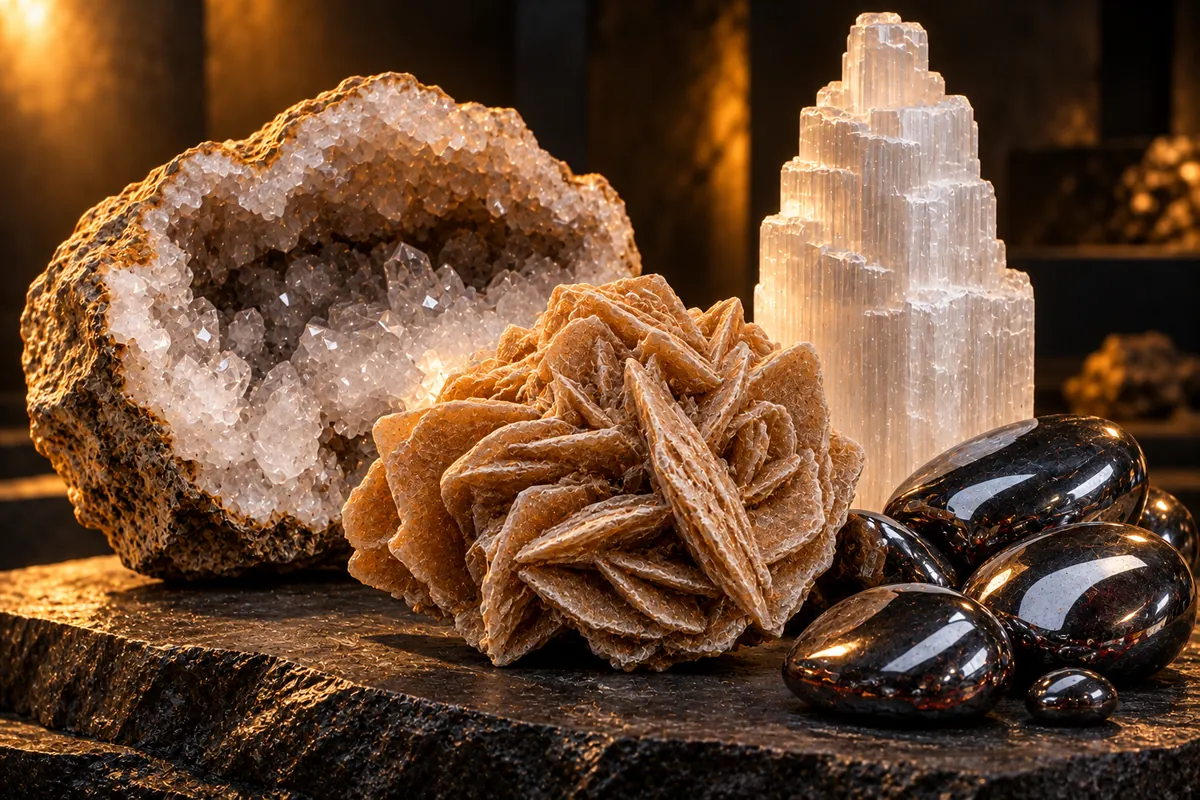
Geodes: hollow rock nodules lined with quartz or calcite crystals. Geodes form in several ways; one well-documented route is silicification of earlier anhydrite nodules in sedimentary rocks[1], another is the filling of gas cavities in volcanic rock.
Amethyst: purple quartz. Morocco’s best-known gem-quality source is Boudi in the Central Anti-Atlas near Tata, where crystals often show hourglass color zoning and red hematite needles[2].
Desert Rose: rosettes of bladed gypsum or barite enclosing sand grains, formed in arid sands near a shallow water table[3].
Selenite: the transparent crystal variety of gypsum, sold as raw crystals and as cut towers, logs and lamps. Gypsum is soft and slightly water-soluble, which affects how it should be displayed.
Hematite: iron oxide, sold raw and tumbled. Important for buyers because much “hematite” jewelry in the trade is man-made.
| Geodes | Quartz or calcite crystals lining a hollow nodule; Mohs 7 (quartz) or 3 (calcite) |
|---|---|
| Amethyst | Purple quartz, SiO2; Mohs 7; Boudi, Tata Province |
| Desert rose | Gypsum or barite rosettes with sand; Mohs 2 (gypsum) |
| Selenite | Transparent gypsum, CaSO4·2H2O; Mohs 2 |
| Hematite | Iron oxide, Fe2O3; Mohs 5–6.5 |
Buying Moroccan stones and rocks for resale
Most shops buy Moroccan stones in flats: a tray of similar-sized pieces at a single lot price, which keeps per-piece cost low and makes restocking simple. Approved wholesale accounts see lot pricing and tiered quantity discounts; for container-size or mixed orders, use Request a Quote. Orders to the USA and Europe ship with legal export paperwork; see Shipping for details.
Honest labeling matters here
Decorative stones are where most mislabeling happens in the wider trade: dyed geodes sold as natural, satin spar sold as “selenite,” synthetic magnetic material sold as hematite, heat-treated amethyst sold as natural citrine. We describe each of our Moroccan stones as what it is and state whether it is natural or repaired. Each family page explains the specific checks to make.
Moroccan stones also travel well when packed correctly. Hard materials such as quartz geodes, amethyst and hematite tolerate normal handling, while gypsum products need individual wrapping and dry storage on arrival.
Looking for collector minerals rather than decor? Visit Moroccan Minerals. For mixed trays of fossils and stones, see Wholesale Lots.
References
- Chowns, T.M., & Elkins, J.E. (1974). The origin of quartz geodes and cauliflower cherts through the silicification of anhydrite nodules. Journal of Sedimentary Petrology 44(3): 885 ff. archives.datapages.com
- Troilo, F., El Harfi, A., Mouaddib, S., Bittarello, E., & Costa, E. (2015). Amethyst from Boudi, Morocco. Gems & Gemology 51(1): 32–40. doi:10.5741/GEMS.51.1.32
- Al-Hussaini, A., Koeshidayatullah, A., & Al-Ramadan, K. (2015). Formation conditions and diagenetic evolution of sand roses in clastic sabkhas along the Arabian Gulf coastal region, eastern Saudi Arabia. Geological Quarterly 59(1): 71–78. doi:10.7306/gq.1207
Frequently asked questions
What is a flat in the stone and mineral trade?
A flat is a shallow tray or box filled with similar specimens, such as small geodes or desert roses, sold together at one lot price. It is the standard wholesale unit for low- to mid-priced material because it keeps per-piece cost down and makes restocking a shop display simple. Flat contents and counts are stated on each listing.
Are Moroccan geodes and stones dyed?
Natural quartz geodes and desert roses are normally sold undyed, but dyed agate and geodes do circulate in the wider trade. Signs of dye include unnaturally bright colors, color concentrated in cracks and uniform tones across many pieces. Our listings state what each product is and whether it is natural.
Which stones in this category are fragile or water-sensitive?
Selenite and gypsum desert roses are very soft, about 2 on the Mohs scale, and slightly soluble in water, so they should be kept dry and dusted rather than washed. Quartz geodes, amethyst and hematite are much harder and can be rinsed, though matrix and glue repairs should still be kept dry.
Can I mix different stones in one wholesale order?
Yes. Many shops combine geodes, desert roses, selenite and hematite in one shipment. Approved wholesale accounts see lot pricing with tiered quantity discounts, and mixed or large orders can be priced through the Request a Quote form. Shipments to the USA and Europe include legal export paperwork.