
Why Morocco produces so many collectible minerals
Morocco sits where several geological stories overlap: Precambrian rocks of the Anti-Atlas, Paleozoic basins folded during the Variscan (Hercynian) orogeny, and Mesozoic carbonate platforms of the Atlas ranges. Each setting trapped metal-bearing fluids in a different way, which is why Moroccan minerals range from lead vanadates to copper carbonates, cobalt arsenates and fluorite of collector quality.
Two processes matter most for specimens. First, hot basinal brines deposited primary ores such as galena, sphalerite and baryte in carbonate rocks, the Mississippi Valley-type (MVT) model documented at Touissit–Bou Beker[1]. Second, near-surface weathering oxidized those primary ores and grew new, often brightly colored minerals in open cavities. Most showy Moroccan minerals are products of this second, supergene stage.
The main localities
Mibladen (Midelt Province). About 25 km northeast of Midelt, this lead–baryte district has been worked since the 1920s. It is famous for vanadinite and is the subject of a full Mineralogical Record monograph[2]. See Vanadinite and Barite & Cerussite.
Touissit–Bou Beker (Jerada Province). A major MVT lead–zinc district on the Morocco–Algeria border whose oxidized zones produced azurite, malachite and cerussite[1]. See Azurite & Malachite.
Bou Azzer (Ouarzazate Province). A cobalt–nickel–arsenic district in the Central Anti-Atlas, described in recent research as the world’s highest-grade cobalt mineralization[3]. Its oxidized veins yield erythrite. See Erythrite.
El Hammam (Central Morocco). North Africa’s largest fluorite deposit, southwest of Meknes[4]. See Fluorite.
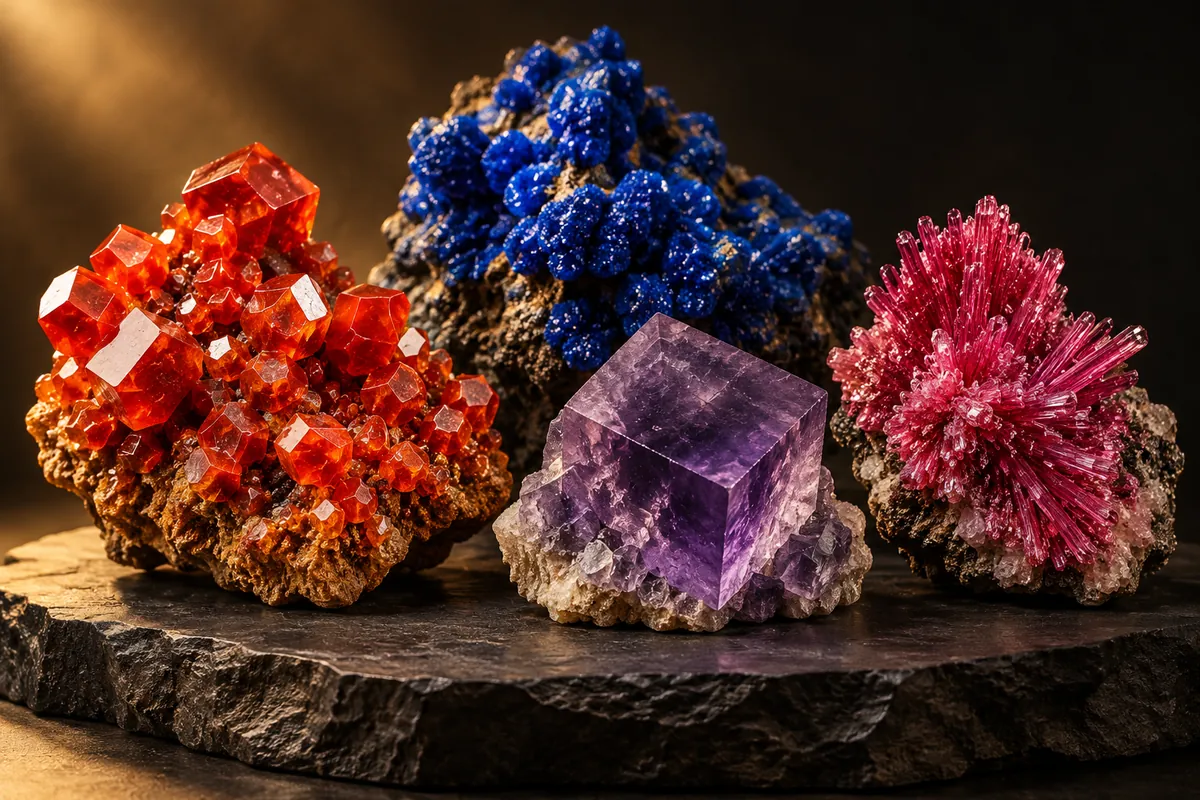
| Vanadinite | Mibladen district, Midelt Province |
|---|---|
| Azurite & malachite | Touissit–Bou Beker, Jerada Province; Kerrouchen, Khénifra Province |
| Erythrite | Bou Azzer district, Ouarzazate Province |
| Fluorite | El Hammam, southwest of Meknes |
| Barite & cerussite | Mibladen; Touissit–Bou Beker |
Buying Moroccan minerals wholesale
Retailers usually buy Moroccan minerals two ways: mixed or graded flats of small to mid-size specimens for counter sales, and individual cabinet pieces for display cases. Approved wholesale accounts see lot pricing and receive tiered quantity discounts; larger or mixed orders can go through Request a Quote. Shipments to the USA and Europe leave with legal export paperwork (see Shipping).
Authenticity and condition
The market for Moroccan minerals is honest for the most part, but repairs exist: crystals reglued to matrix, broken plates rebuilt, and occasionally crystals from one piece added to another. A loupe, raking light and a UV lamp (many glues fluoresce) catch most of it. Our listings say plainly whether a specimen is natural or repaired. Several of these minerals contain lead or arsenic, so handle them like any lab specimen: wash hands, keep away from children, and never use them in food or water.
For decorative stones such as geodes, amethyst and selenite, see Stones & Rocks. For bulk trays of minerals and fossils, see Wholesale Lots.
References
- Bouabdellah, M., Sangster, D.F., Leach, D.L., Brown, A.C., Johnson, C.A., & Emsbo, P. (2012). Genesis of the Touissit–Bou Beker Mississippi Valley-type district (Morocco–Algeria) and its relation to the Africa–Europe collision. Economic Geology 107(1): 117–146. doi:10.2113/econgeo.107.1.117
- Praszkier, T. (2013). Famous mineral localities: Mibladen, Morocco. Mineralogical Record 44(3): 247–285. mineralogicalrecord.com
- Saintilan, N.J., Ikenne, M., Bernasconi, S.M., Toma, J., Creaser, R.A., Souhassou, M., Allaz, J.M., Karfal, A., Maacha, L., & Spangenberg, J.E. (2023). The world’s highest-grade cobalt mineralization at Bou Azzer associated with Gondwana supercontinent breakup, serpentinite and Kellwasser hydrocarbon source rocks. American Journal of Science 323: 12. doi:10.2475/001c.91400
- Bouabdellah, M., et al. (2016). Geology and mineralogy of the El Hammam REE-rich fluorite deposit (Central Morocco): a product of transtensional Pangean rifting and Central Atlantic opening. In: Bouabdellah, M. & Slack, J.F. (eds.), Mineral Deposits of North Africa. Mineral Resource Reviews. Springer, Cham. doi:10.1007/978-3-319-31733-5_12
Frequently asked questions
Which Moroccan minerals sell best in a rock shop?
Vanadinite from Mibladen is the classic Moroccan best seller because of its strong red color and sharp hexagonal crystals at modest prices. Azurite with malachite, green fluorite and pink erythrite add color variety to a display. Many shops start with mixed flats of small specimens and add a few larger cabinet pieces as focal points.
Are Moroccan mineral specimens ever repaired or enhanced?
Yes, some are. Common work includes regluing detached crystals, rebuilding broken matrix plates and, more rarely, combining crystals from different pieces. Dyeing is a concern mainly for decorative stones, not for vanadinite or erythrite. Our listings state whether each specimen is natural or repaired, and buyers can check with a loupe and a UV lamp.
Is it safe to handle vanadinite and erythrite?
Handled normally, yes, but both contain toxic elements: vanadinite is a lead vanadate and erythrite a cobalt arsenate. Wash your hands after handling, avoid making dust, keep specimens away from small children and pets, and never place them in drinking water or use them for so-called gem elixirs.
Can I order Moroccan minerals in bulk for resale?
Yes. Apply for a wholesale account to see lot pricing and tiered quantity discounts. For mixed orders combining minerals, fossils and decorative stones, use the Request a Quote form. Shipments to the USA and Europe are sent with legal export paperwork.