
What vanadinite is
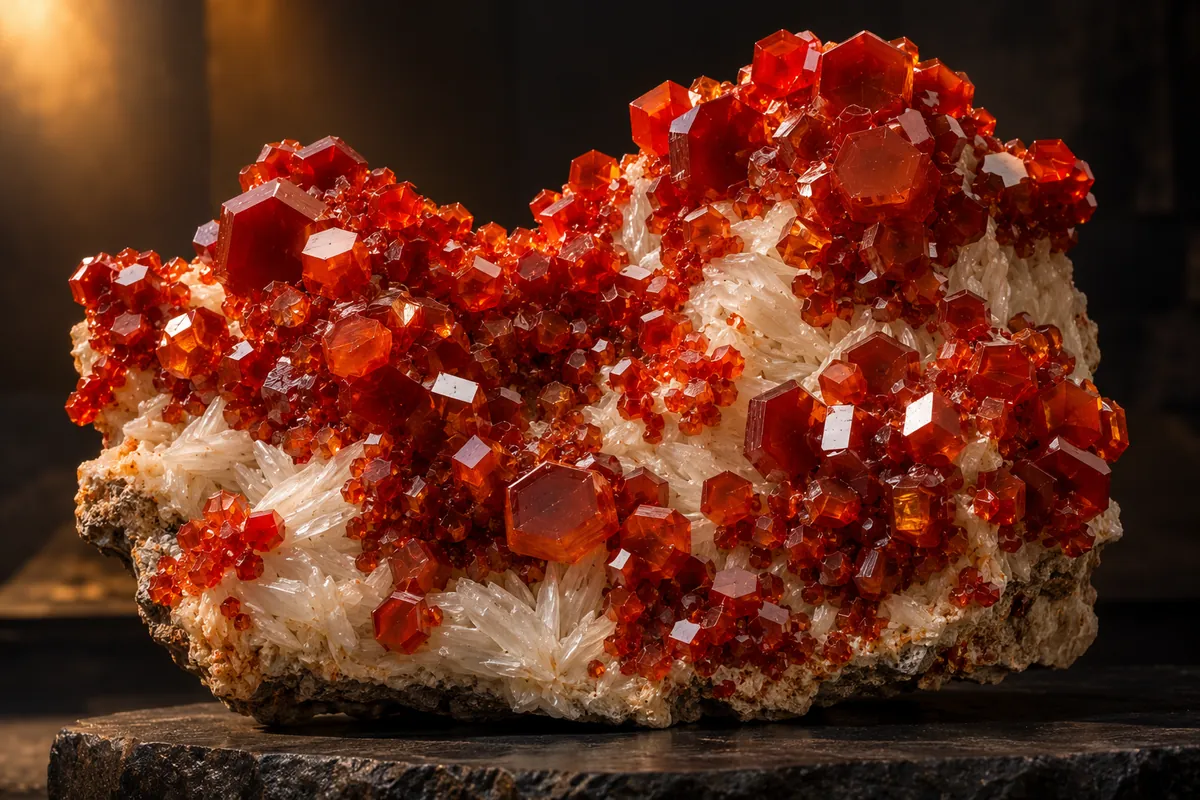
Vanadinite is a lead vanadate chloride, Pb5(VO4)3Cl, a member of the apatite group. It forms in the oxidized upper parts of lead deposits, where weathering breaks down galena and releases lead that combines with vanadium carried by groundwater. The result is a heavy mineral (specific gravity near 7) with an adamantine to resinous luster and crystals that are usually short hexagonal prisms or flat hexagonal plates.
Color runs from orange and cherry red to brown and nearly black. In Moroccan vanadinite the red tones dominate, which is why Mibladen material is among the best-known vanadinite in collections worldwide.
| Chemical formula | Pb5(VO4)3Cl |
|---|---|
| Crystal system | Hexagonal |
| Mohs hardness | about 3–4 (sources differ) |
| Moroccan locality | Mibladen mining district, about 25 km NE of Midelt, Midelt Province |
| Typical habit | Short hexagonal prisms and plates, often on barite or limestone matrix |
The Mibladen district
Mibladen lies in the Upper Moulouya valley, northeast of Midelt in Drâa-Tafilalet Region. The deposit is a stratiform lead–baryte body hosted in Early Jurassic (Liassic) limestones and dolomites[1]. Structural work shows that galena and barite filled karst cavities, bedding joints, collapse breccias and faults, and that the main mineralizing fluids moved along regional faults such as the Aouli and Amourou faults[2]. Later oxidation of this ore produced the Moroccan vanadinite collectors know.
French companies worked the district between 1926 and 1949, sinking more than 600 shafts grouped into named sectors such as Les AB, Les S and Anne-Marie. Today local miners rework old workings for baryte and cerussite and sink small shafts specifically for vanadinite[1]. The Coud’a workings, an elongated plain about 2 km long, are recorded as one of the two most important sources of top-quality vanadinite in the area; a large system of pockets was opened there in June 2001[3]. The best single overview of the district’s history and mineralogy is Praszkier’s Mineralogical Record monograph[4].
How to judge a vanadinite specimen
- Color and luster: saturated red with a glassy shine scores highest. Brown or dull crystals are common and priced lower.
- Crystal sharpness: look for clean hexagonal outlines and intact terminations. Vanadinite is soft and brittle, so chipped edges are frequent.
- Matrix contrast: red crystals on white barite photograph and sell better than crystals on dark limestone.
- Coverage and size: dense, even coverage matters more to most buyers than one large crystal.
Size grades in the trade
Moroccan vanadinite is usually graded by specimen size: thumbnails (up to about 2.5 cm), miniatures (about 2.5–5 cm), small cabinet pieces (about 5–10 cm) and larger cabinet plates. Crystal size is a separate measure: most crystals measure a few millimeters to about a centimeter, and larger crystals command premium prices. Each listing gives exact dimensions and weight, so grades are easy to compare across lots.
Repairs, glue and honest disclosure
Because Moroccan vanadinite pockets break easily during extraction, some specimens are reassembled. The usual issues are crystals reglued onto matrix, cracked plates stabilized with resin and, occasionally, composite pieces made from separate fragments. Check where crystals meet the matrix with a loupe, look for shiny glue lines under raking light, and use a UV lamp, since many adhesives fluoresce. Our listings state whether each piece is natural or repaired.
Handling and care
Moroccan vanadinite, like all vanadinite, contains lead. Normal handling is fine, but wash hands afterward, do not create dust by scrubbing or cutting, and keep specimens out of reach of young children. Dust with a soft brush or compressed air. Do not soak in water or use ultrasonic cleaners, which can loosen crystals.
Buying Moroccan vanadinite wholesale
For shops, flats of thumbnail to miniature specimens are the most practical format, with a few cabinet plates as display anchors. Approved accounts see lot pricing and tiered quantity discounts: apply for a wholesale account or send a quote request for mixed orders. Vanadinite pairs naturally with barite and cerussite from the same district; for other localities, return to Moroccan Minerals.
References
- Mindat.org, Hudson Institute of Mineralogy (n.d.). Mibladen Mining District, Midelt Province, Drâa-Tafilalet Region, Morocco. Mindat locality database. Accessed 29 October 2026. mindat.org/loc-2396
- Yaagoub, D., Hinaje, S., El Fartati, M., & Gharmane, Y. (2021). Analysis of tectonic fracturing in the Mibladen ore deposit (Upper Moulouya, Morocco) and its impact on the Pb–Ba mineralization emplacement. Rendiconti Lincei. Scienze Fisiche e Naturali 32(2): 325–342. doi:10.1007/s12210-021-00995-1
- Mindat.org, Hudson Institute of Mineralogy (n.d.). Coud’a workings, Mibladen, Midelt Province, Morocco. Mindat locality database. Accessed 29 October 2026. mindat.org/loc-245663
- Praszkier, T. (2013). Famous mineral localities: Mibladen, Morocco. Mineralogical Record 44(3): 247–285. mineralogicalrecord.com
Frequently asked questions
Where does Moroccan vanadinite come from?
Almost all collector-grade Moroccan vanadinite comes from the Mibladen mining district in the Upper Moulouya valley, about 25 km northeast of Midelt in Midelt Province. The district was worked industrially for lead and baryte from 1926 to 1949; today local miners dig small shafts and rework old workings, including the Coud'a area, for specimens.
Why are some vanadinite crystals red and others brown?
Vanadinite's color varies with crystal size, trace chemistry and growth conditions, so one district can produce orange, cherry-red, brown and nearly black crystals. Thin, glassy red crystals are the most sought after. Color alone does not prove authenticity, but unnaturally uniform color or a painted look should prompt a closer inspection.
How can I tell if a vanadinite specimen has been repaired?
Examine the contact between crystals and matrix with a 10x loupe. Look for glossy glue films, mismatched matrix color, or crystals oriented in ways that make no growth sense. Many glues glow under a UV lamp. A reputable seller should disclose repairs; our listings state whether each piece is natural or repaired.
Is vanadinite toxic?
Vanadinite contains lead and vanadium, so it should not be ingested, ground into dust or placed in water. Handling a specimen is not dangerous if you wash your hands afterward. Keep it in a display case or on a shelf out of reach of small children and pets.