
Two heavy minerals from lead country
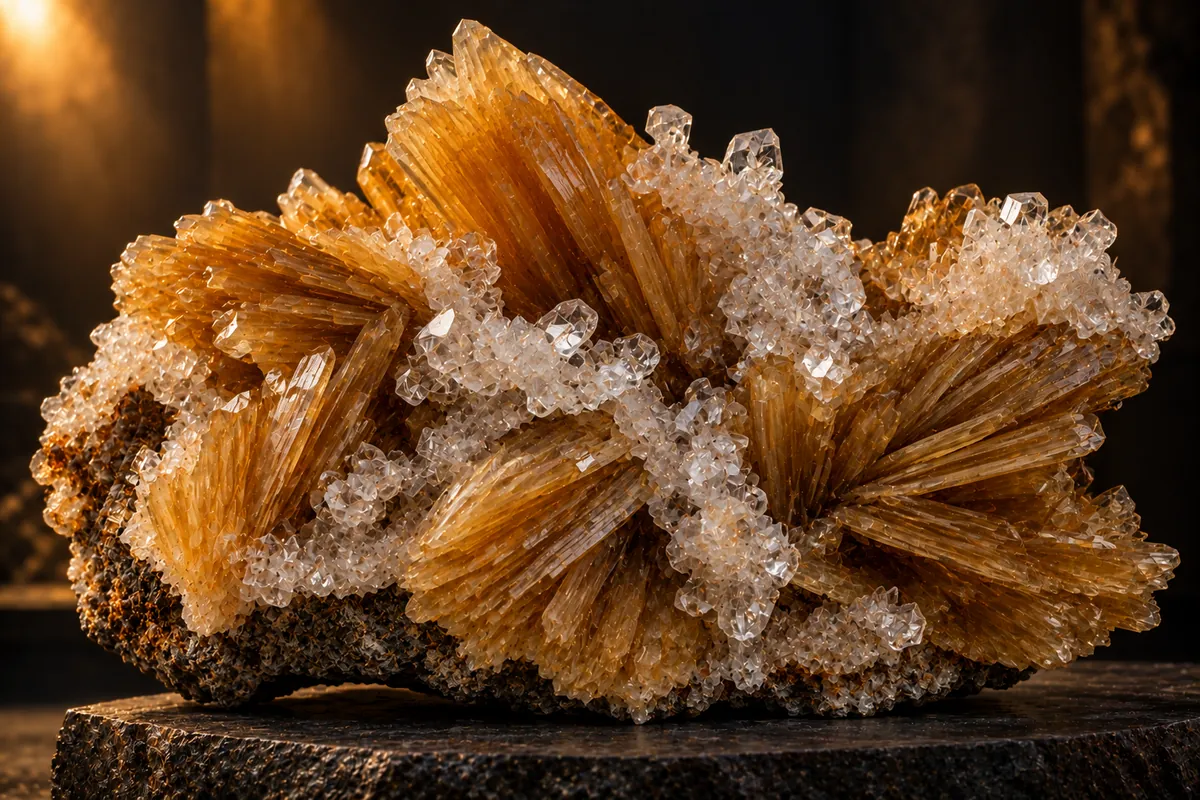
Barite (baryte), BaSO4, is barium sulfate. It is notably heavy for a light-colored mineral (specific gravity about 4.5) and forms tabular or bladed crystals, sometimes in rosettes. Cerussite, PbCO3, is lead carbonate, heavier still (about 6.5), with an adamantine luster that makes clear crystals look almost diamond-like. Cerussite is famous for twinning: crystals grow together in V-shapes, hearts and six-rayed “snowflake” or reticulated groups.
Moroccan barite at Mibladen is primarily a hydrothermal ore mineral, deposited alongside galena. Cerussite is secondary: it forms when galena (lead sulfide) weathers near the surface and lead combines with carbonate in groundwater.
| Chemical formula | Barite BaSO4; cerussite PbCO3 |
|---|---|
| Crystal system | Orthorhombic (both) |
| Mohs hardness | 3–3.5 (both) |
| Moroccan locality | Mibladen district, Midelt Province; Touissit–Bou Beker district, Jerada Province |
| Typical habit | Barite: tabular blades and rosettes; cerussite: prismatic, twinned and reticulated crystals |
Mibladen: Moroccan barite with vanadinite, wulfenite and galena
Mibladen’s ore is a stratiform baryte–galena deposit in Early Jurassic limestones and dolomites[1]. Structural analysis classifies it as Mississippi Valley-type, with galena and barite as the dominant ore minerals filling karst cavities, joints, breccias and faults, plus minor chalcopyrite, pyrite and supergene oxidation minerals[2]. Today local miners rework old workings for baryte and cerussite[1]. Mindat’s record for the Coud’a workings lists wulfenite, cerussite, baryte, galena, mottramite and gypsum alongside vanadinite[3], which explains the colorful combinations on the market: red vanadinite or orange wulfenite on white barite, sometimes with cerussite and gray galena.
Touissit–Bou Beker: cerussite country
In the Touissit–Bou Beker MVT district, galena and sphalerite fill a dolomitized Middle Jurassic carbonate sequence[4]. Oxidation of that galena generated cerussite, and collectors know the district for cerussite together with anglesite and azurite. Expect the specific locality on each listing.
Barite as an everyday specimen
Moroccan barite is one of the most affordable display minerals from these districts. Plain white or cream blade clusters without a second species suit educational sets, mixed flats and decor, while combinations with vanadinite or wulfenite belong in the specimen case. Grading by size and by the presence of associated minerals keeps pricing consistent.
How to evaluate barite and cerussite
- Moroccan barite: look for crisp, well-separated blades with clean edges. Golden or honey tones and good transparency add value.
- Cerussite: clarity, luster and twin geometry decide price. Reticulated groups are fragile and should be checked under magnification.
- Associations: a second species (vanadinite, wulfenite, galena) turns a plain specimen into a display piece.
- Weight check: both minerals feel heavy in the hand, a quick sanity test against glass or resin imitations.
Repairs and disclosure
Moroccan barite blades and cerussite twins break easily. Reattached crystals and stabilized matrix are the main issues. Combined specimens, where a crystal from one piece is glued onto another, are less common but exist. Inspect contact points with a loupe and UV lamp. Our listings state whether each piece is natural or repaired.
Care and safety
Cerussite is a lead mineral: wash hands after handling and keep it out of reach of children. It is also brittle and somewhat heat sensitive, so avoid temperature shocks. Barite is stable but soft. Clean both with a dry brush or compressed air rather than water.
For wholesale buyers
Moroccan barite clusters are an affordable volume line; cerussite and multi-species combinations work as premium pieces. Apply for a wholesale account for lot pricing and tiered quantity discounts, or use Request a Quote. All exports to the USA and Europe ship with legal paperwork. See all Moroccan Minerals.
References
- Mindat.org, Hudson Institute of Mineralogy (n.d.). Mibladen Mining District, Midelt Province, Drâa-Tafilalet Region, Morocco. Mindat locality database. Accessed 29 October 2026. mindat.org/loc-2396
- Yaagoub, D., Hinaje, S., El Fartati, M., & Gharmane, Y. (2021). Analysis of tectonic fracturing in the Mibladen ore deposit (Upper Moulouya, Morocco) and its impact on the Pb–Ba mineralization emplacement. Rendiconti Lincei. Scienze Fisiche e Naturali 32(2): 325–342. doi:10.1007/s12210-021-00995-1
- Mindat.org, Hudson Institute of Mineralogy (n.d.). Coud’a workings, Mibladen, Midelt Province, Morocco. Mindat locality database. Accessed 29 October 2026. mindat.org/loc-245663
- Bouabdellah, M., Sangster, D.F., Leach, D.L., Brown, A.C., Johnson, C.A., & Emsbo, P. (2012). Genesis of the Touissit–Bou Beker Mississippi Valley-type district (Morocco–Algeria) and its relation to the Africa–Europe collision. Economic Geology 107(1): 117–146. doi:10.2113/econgeo.107.1.117
Frequently asked questions
Why is Moroccan barite so often sold with vanadinite?
At Mibladen, barite is a primary ore mineral that formed with galena, and vanadinite grew later during weathering of the lead ore. Vanadinite crystals therefore often sit directly on barite blades. The red-on-white contrast is so attractive that barite with vanadinite became one of the best-known Moroccan specimen types.
What are cerussite twins?
Cerussite crystals often grow intergrown according to fixed crystallographic rules, forming V-shaped twins, heart shapes, six-rayed stars and lattice-like reticulated groups. These twinned forms are prized by collectors. They are also fragile, so check carefully for breaks and repairs before buying.
Does Morocco produce wulfenite with barite?
Yes. Mindat records wulfenite, a lead molybdate, at the Coud'a workings in the Mibladen district, alongside barite, cerussite, galena and vanadinite. Orange to yellow wulfenite plates on white barite occur in the trade. Each listing states the specific locality and whether the specimen is natural or repaired.
Is cerussite safe to handle?
Cerussite is lead carbonate, so treat it like other lead minerals: handling is fine, but wash your hands afterward, avoid creating dust and keep pieces out of reach of children and pets. Never put it in water or near food. Barite contains no lead and is chemically very stable.