
What erythrite is
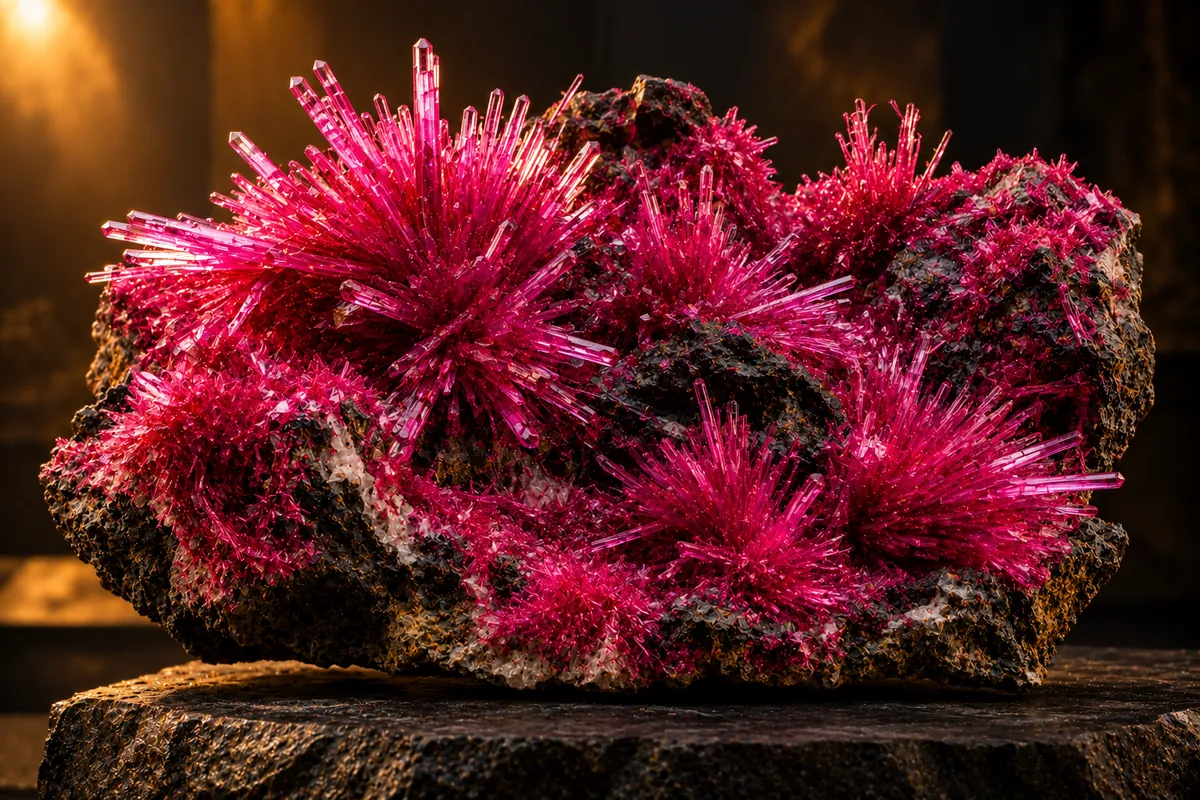
Erythrite is a hydrated cobalt arsenate, Co3(AsO4)2·8H2O, belonging to the vivianite group. Miners called it “cobalt bloom” because its pink crust on weathered rock signaled cobalt ore below. It forms in the oxidation zone of cobalt arsenide deposits, where primary minerals such as skutterudite break down and cobalt and arsenic recombine with water and oxygen. It is soft (Mohs 1.5–2.5), has one perfect cleavage, and its thin blades are flexible.
| Chemical formula | Co3(AsO4)2·8H2O |
|---|---|
| Crystal system | Monoclinic |
| Mohs hardness | 1.5–2.5 |
| Moroccan locality | Bou Azzer mining district, Ouarzazate Province, Central Anti-Atlas |
| Typical habit | Bladed to prismatic crystals in sprays and radiating groups; also crusts |
The Bou Azzer cobalt district
Bou Azzer lies in Ouarzazate Province in the Central Anti-Atlas. The ores sit in fault zones at the contact between Neoproterozoic serpentinite (altered mantle rock from an ancient ophiolite) and Pan-African diorite, and in veins cutting both rocks. The primary minerals are cobalt and nickel arsenides: safflorite, skutterudite, rammelsbergite, nickeline and löllingite. Rhenium–osmium dating of safflorite places the main mineralization in the Late Devonian, roughly 380 to 368 million years ago, and the authors describe Bou Azzer as the world’s highest-grade cobalt mineralization[1].
Bou Azzer erythrite came much later, during near-surface weathering. A detailed geochemical study of Bou Azzer erythrite found it with skutterudite, roselite and alloclasite in a quartz–feldspar–carbonate matrix, and documented fine oscillatory zoning with unusually high magnesium contents, the highest reported in erythrite at the time[2]. The magnesium came from host minerals such as dolomite, which shows how closely the specimen reflects its local rock.
For collectors, this history explains why Bou Azzer erythrite is so closely tied to its locality. The district combines very cobalt-rich primary ore with long exposure to weathering, the two ingredients erythrite needs. A specimen labeled with the district name tells a buyer which ore system it came from, and that context is a large part of its value.
Judging Bou Azzer erythrite
- Color: deep raspberry to purple-pink is preferred; pale pink crusts are common and lower-grade.
- Crystal form: distinct, lustrous blades in sprays or “starbursts” are the collector standard.
- Matrix: contrast with white calcite or quartz, or with dark gray skutterudite, adds value and context.
- Damage: blades bend and break easily, so inspect tips closely.
Repairs and authenticity
Erythrite is too soft and complex to fake convincingly, but specimens can be repaired: crystal sprays reattached, cracked matrix stabilized. Check joints with a loupe and UV light. Avoid any piece with a glossy, coated look, as some sellers spray soft minerals with lacquer to “freshen” color. Our listings state whether each specimen is natural or repaired.
Safety and care
Bou Azzer erythrite contains arsenic and cobalt. Displayed in a case or on a shelf it is safe, but do not lick, grind or cut it, do not place it in water, and wash your hands after handling. Keep it away from children and pets. It is also sensitive to heat and can lose water and change color if warmed, so keep it away from lamps and sunny windows. Dust with a soft brush; never wash it.
Ordering
Bou Azzer erythrite is usually sold as individual pieces rather than in bulk because quality varies widely between specimens. Collectors can buy directly from this page. Shops can apply for a wholesale account or ask for a selection through Request a Quote. For more Moroccan species, see Vanadinite, Fluorite or the full Moroccan Minerals collection.
References
- Saintilan, N.J., Ikenne, M., Bernasconi, S.M., Toma, J., Creaser, R.A., Souhassou, M., Allaz, J.M., Karfal, A., Maacha, L., & Spangenberg, J.E. (2023). The world’s highest-grade cobalt mineralization at Bou Azzer associated with Gondwana supercontinent breakup, serpentinite and Kellwasser hydrocarbon source rocks. American Journal of Science 323: 12. doi:10.2475/001c.91400
- Dumańska-Słowik, M., Pieczka, A., Natkaniec-Nowak, L., et al. (2018). Mg-enriched erythrite from Bou Azzer, Anti-Atlas Mountains, Morocco: geochemical and spectroscopic characteristics. Mineralogy and Petrology 112: 381–392. doi:10.1007/s00710-017-0545-8
Frequently asked questions
Why is Bou Azzer erythrite so famous?
Bou Azzer, in Morocco's Central Anti-Atlas, is an exceptionally rich cobalt arsenide district, and the weathering of its ores produced erythrite crystals of unusual size, color and luster. Specimens from Bou Azzer are widely regarded by collectors as the classic reference material for the species.
Is erythrite dangerous to own?
Erythrite contains arsenic and cobalt, so it must not be ingested, ground into dust or placed in water. Displayed normally, it poses no meaningful risk. Wash your hands after handling, keep specimens in a case or on a high shelf, and keep them away from children and pets.
What minerals occur with erythrite at Bou Azzer?
Published research on Bou Azzer erythrite reports it with skutterudite, roselite and alloclasite in a quartz, feldspar and carbonate matrix. Primary ores in the district include safflorite, skutterudite, rammelsbergite and nickeline. Calcite is a common white matrix that gives pink erythrite strong contrast.
How should I store erythrite?
Keep erythrite dry, cool and out of direct sunlight or lamp heat, since warming can drive off water and alter its color. Do not wash it. Store it upright in a closed case with soft padding so the delicate blades do not touch other specimens, and dust only with a soft brush.