
Fluorite basics
Fluorite is calcium fluoride, CaF2, and the reference mineral for hardness 4 on the Mohs scale. It crystallizes in the cubic system, most often as cubes, less often as octahedra, and it has perfect octahedral cleavage, meaning it splits cleanly along four directions. That cleavage is why fluorite chips easily and why cleaved “octahedrons” are sold in the decorative trade.
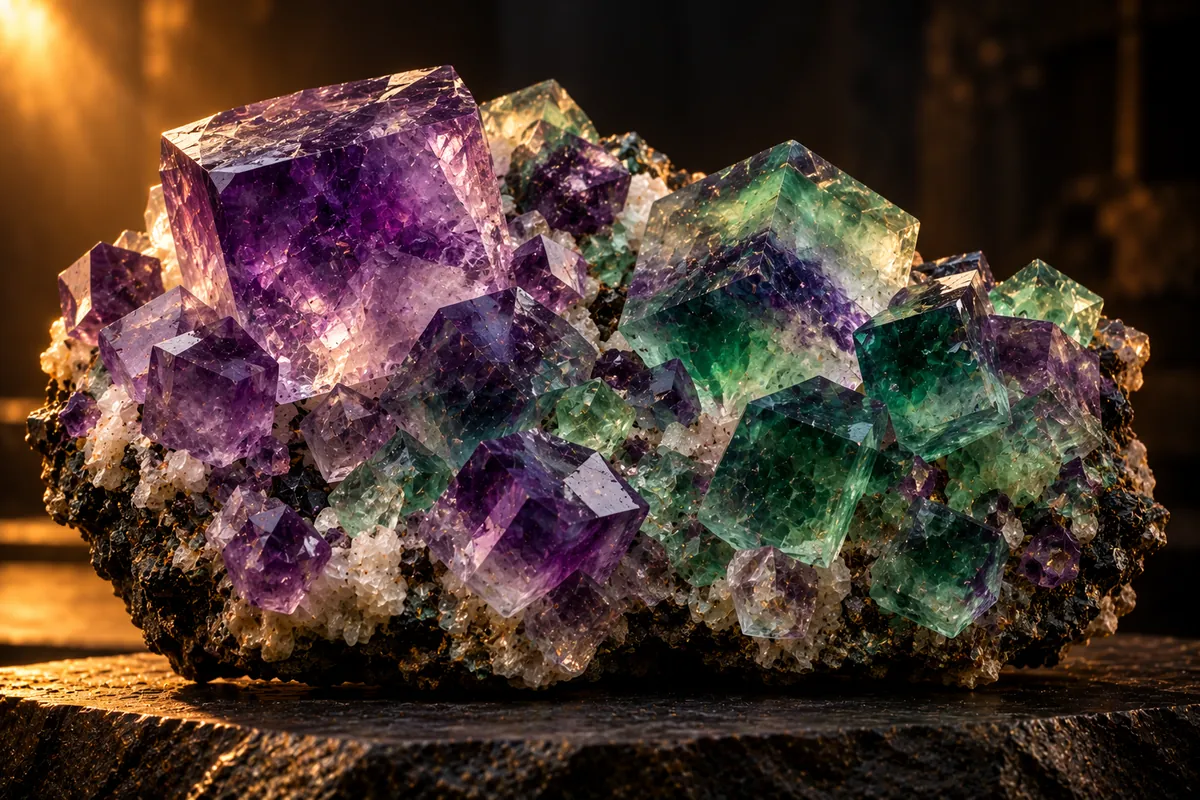
Pure fluorite is colorless. Its famous range of greens, purples, blues and yellows comes from trace elements, especially rare earth elements, and from defects in the crystal lattice. Many fluorites glow under ultraviolet light; the word “fluorescence” derives from this mineral.
| Chemical formula | CaF2 |
|---|---|
| Crystal system | Cubic (isometric) |
| Mohs hardness | 4 |
| Moroccan locality | El Hammam, on the Beht River about 50 km SW of Meknes, Central Morocco |
| Typical habit | Cubes and cube clusters, often with calcite and quartz |
The El Hammam deposit
El Hammam is the largest fluorite deposit in North Africa and has produced on the order of 110,000 tonnes of 98% fluorite concentrate per year[1]. The ore occurs in veins within folded and metamorphosed Silurian to Namurian (Carboniferous) sedimentary and volcaniclastic rocks, cut by late Hercynian granite stocks. Most ore bodies follow the El Hammam shear zone, where three major vein systems carry fluorite with calcite, quartz, sulfides and minor siderite and adularia[1].
The green fluorite here is notably rich in rare earth elements and yttrium. Fluid-inclusion data point to hot (about 92–176 °C), very saline basinal brines[1]. Researchers agree the deposit formed in the early Mesozoic, linked to the rifting that opened the Central Atlantic, but the exact timing is debated: one study reported a Late Triassic 40Ar/39Ar age and proposed a link to the Central Atlantic Magmatic Province[2], while other authors questioned that interpretation in a published comment[3]. For buyers of Moroccan fluorite, the practical point is simple: El Hammam is a well-studied deposit with documented provenance.
Choosing Moroccan fluorite for display or resale
- Color and transparency: clean, translucent green is the classic look. Zoning and color bands add interest.
- Crystal edges: because of cleavage, check corners and edges for chips and bruises.
- Associations: white calcite or sparkling quartz alongside fluorite gives contrast and context.
- Fluorescence: test with a UV lamp; a fluorescent piece is a strong talking point in a shop.
Moroccan fluorite also displays well with backlighting. A small LED placed behind or beneath a translucent cluster brings out the green color and any internal zoning. Keep the light source cool, since fluorite is sensitive to heat, and avoid halogen spotlights close to the specimen.
Repairs and treatments
Moroccan fluorite cubes sometimes detach during mining and are glued back. Inspect contact points with a loupe and UV lamp. Irradiation and coating are reported in the wider fluorite trade, and polished free-form pieces may be stabilized. Our listings state whether a specimen is natural or repaired; if you need detail on any piece, ask before ordering.
Care
Moroccan fluorite, like all fluorite, is soft and heat-sensitive. Avoid sudden temperature changes (no hot water, no sunny windowsills in summer), which can crack crystals along cleavage planes. Clean with lukewarm water and a soft brush only if the piece has no glue, and dry it gently. Some colors can fade with long exposure to strong light.
Wholesale orders
Moroccan fluorite is a steady seller in both specimen flats and mixed mineral lots. Apply for a wholesale account to see lot pricing with tiered quantity discounts, or send a quote request. Combine it with azurite or vanadinite for a colorful Moroccan assortment, or browse all Moroccan Minerals.
References
- Bouabdellah, M., et al. (2016). Geology and mineralogy of the El Hammam REE-rich fluorite deposit (Central Morocco): a product of transtensional Pangean rifting and Central Atlantic opening. In: Bouabdellah, M. & Slack, J.F. (eds.), Mineral Deposits of North Africa. Mineral Resource Reviews. Springer, Cham. doi:10.1007/978-3-319-31733-5_12
- Cheilletz, A., Gasquet, D., Filali, F., Archibald, D.A., & Nespolo, M. (2010). A late Triassic 40Ar/39Ar age for the El Hammam high-REE fluorite deposit (Morocco): mineralization related to the Central Atlantic Magmatic Province? Mineralium Deposita 45(4): 323–329. doi:10.1007/s00126-010-0282-y
- Bouabdellah, M., Banks, D., & Kluegel, A. (2010). Comments on the Cheilletz et al. (2010) paper on a late Triassic 40Ar/39Ar age for the El Hammam high-REE fluorite deposit, Morocco, and its possible link to the Central Atlantic Magmatic Province. Mineralium Deposita 45(7): 729–731. doi:10.1007/s00126-010-0288-5
Frequently asked questions
Where does Moroccan fluorite come from?
The main source is El Hammam in central Morocco, about 50 km southwest of Meknes on the Beht River. It is North Africa's largest fluorite deposit. Fluorite there fills veins along the El Hammam shear zone in folded Paleozoic rocks, together with calcite, quartz and sulfides.
Why does fluorite glow under UV light?
Fluorescence in fluorite is usually caused by trace elements, especially rare earth elements such as europium, and by lattice defects that absorb ultraviolet light and re-emit visible light. El Hammam fluorite is notably rich in rare earth elements, but the strength and color of fluorescence varies from piece to piece, so test each one.
Can I clean fluorite with water?
Yes, briefly, using lukewarm water and a soft brush, then dry it gently. Avoid hot water, ultrasonic cleaners and sudden temperature changes, because fluorite's perfect cleavage makes it prone to cracking. Do not wash specimens that have glued repairs, and never use acids.
Is fluorite good for a wholesale assortment?
Yes. Fluorite offers color, transparency and often fluorescence at accessible prices, and it pairs well with other Moroccan minerals. Flats of small cube clusters suit counter sales, while larger plates work as display pieces. Approved wholesale accounts see lot pricing and tiered quantity discounts.