
Amethyst in brief
Amethyst is the purple variety of quartz, SiO2, with a hardness of 7 and no cleavage, which makes it durable for display and handling. Its color is linked to trace iron in the crystal structure combined with natural irradiation over geological time. The color is not permanent under all conditions: strong heat changes it, and many “citrine” stones on the market are heat-treated amethyst. Colored quartz varieties in general owe their color to a trace component other than silicon, often activated by natural radiation, and can be altered by heating or irradiation[1].
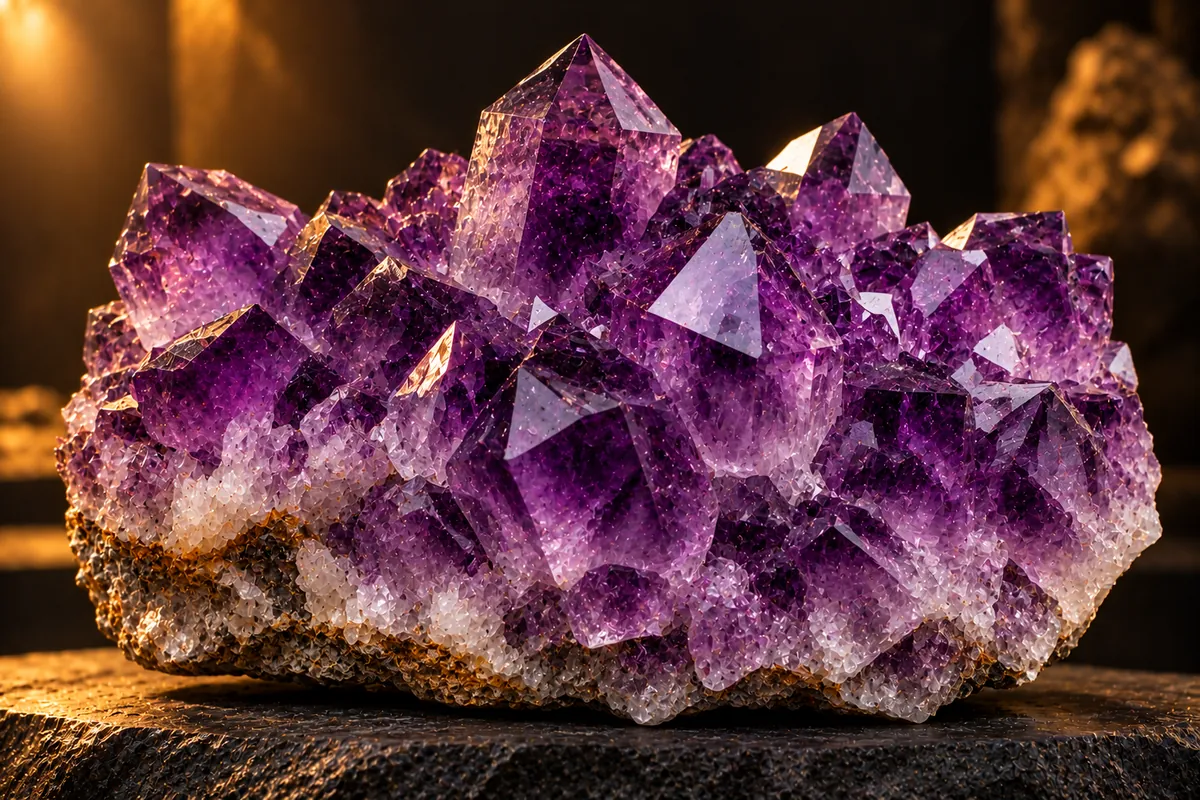
| Chemical formula | SiO2 |
|---|---|
| Crystal system | Trigonal |
| Mohs hardness | 7 |
| Moroccan locality | Boudi, about 30 km NE of Tata, Central Anti-Atlas (Tata Province) |
| Typical habit | Single prismatic crystals, often doubly terminated; also crystals in matrix |
The Boudi deposit
The most detailed published account of Moroccan amethyst is a 2015 Gems & Gemology study of the Boudi deposit[2]. Its key findings for buyers:
- Setting: Boudi is a village in the arid Central Anti-Atlas about 30 km northeast of Tata. The amethyst occurs in the Lower Cambrian Issafen Formation, a siltstone–sandstone unit, in a fractured zone crossed by hydrothermal veins on the flank of an anticline.
- Occurrence: crystals grew in hydrothermal veins and fractures and were later redeposited in reddish mudstones, so many are found loose, without matrix. The authors describe the deposit as both primary and secondary.
- Crystal form: mostly well-formed, usually singly terminated but sometimes doubly terminated.
- Color: light purple to deep purplish red, often concentrated sharply along the rhombohedral faces to form an hourglass pattern that fades to colorless toward the surface.
- Inclusions: needle-like red inclusions identified as hematite are common, especially in deeply colored crystals.
- Mining: open-pit quarrying began in early 2013; crystals are cleaned by washing and a short soak in dilute hydrochloric acid to remove crusts.
The hematite needles connect this material to our hematite category: the same iron oxide, here trapped as microscopic inclusions.
Evaluating Moroccan amethyst
- Color saturation and zoning: deep purple to purplish red with a crisp hourglass pattern is the signature look. Hold crystals against light to see it.
- Terminations: doubly terminated crystals and undamaged tips command higher prices.
- Clarity: clean areas suit faceting; included crystals with hematite needles suit specimen buyers.
- Surface: acid-cleaned crystals are bright; check for remaining red mud in recesses.
Moroccan amethyst for collectors and shops
Because many Boudi crystals were recovered loose from mudstone rather than broken from cavity walls, Moroccan amethyst is often sold as individual, fully formed crystals instead of clusters or geode sections. That sets it apart from the amethyst most shops already stock, and it gives staff a good story to tell. Loose Moroccan amethyst crystals also pack efficiently and suffer less transit damage than large plates.
Treatments and honest labeling
The main treatment in amethyst is heating, which can turn it yellow to orange and is used to make “citrine.” Heated material should be disclosed. Glued crystal clusters and dyed quartz exist in the broader trade. Natural Boudi crystals with zoning and inclusions are difficult to imitate; our listings state whether each piece is natural or repaired.
Care
Amethyst can fade with long exposure to strong sunlight. Display it away from bright windows and spotlights that run hot. Clean with lukewarm water and mild soap, then dry. Avoid sudden temperature changes.
Ordering amethyst
Single display crystals suit collectors; graded lots suit shops and jewelry makers. Apply for a wholesale account to see lot pricing and tiered quantity discounts, or send a quote request. Moroccan amethyst sits well beside quartz geodes; see the full Stones & Rocks range.
References
- Rossman, G.R. (1994). The colored varieties of the silica minerals. In: Heaney, P.J., Prewitt, C.T. & Gibbs, G.V. (eds.), Silica: Physical Behavior, Geochemistry and Materials Applications. Reviews in Mineralogy 29: 433–468. Mineralogical Society of America. CaltechAUTHORS
- Troilo, F., El Harfi, A., Mouaddib, S., Bittarello, E., & Costa, E. (2015). Amethyst from Boudi, Morocco. Gems & Gemology 51(1): 32–40. doi:10.5741/GEMS.51.1.32
Frequently asked questions
Where is Moroccan amethyst mined?
The best-documented Moroccan source is Boudi, a village about 30 km northeast of Tata in the Central Anti-Atlas. Amethyst there occurs in Lower Cambrian siltstones and sandstones of the Issafen Formation and in reddish mudstones where crystals were redeposited. Open-pit production began in 2013, according to a 2015 Gems & Gemology study.
What is hourglass zoning in amethyst?
In many Boudi crystals, the purple color is concentrated in sectors beneath the rhombohedral faces and fades toward the surface. Viewed from the side, the colored zones form an hourglass outline. It reflects how trace iron was taken into different growth sectors and is a useful recognition feature for this material.
What are the red needles inside some amethyst?
In Moroccan amethyst from Boudi, the fine red needle-like inclusions have been identified as hematite, an iron oxide. They are most common in deeply colored crystals. Collectors value them as a natural feature, while faceters usually choose cleaner material. Both are natural parts of the crystal.
Does amethyst fade in sunlight?
Yes, amethyst color can lighten with prolonged exposure to strong sunlight or heat, because both affect the color centers that cause the purple. Display it away from sunny windows and hot spotlights, and never heat it. Brief normal handling and indoor light are not a problem.