
Limestone, not true marble
The stone sold as fossil marble from Morocco is not marble in the geological sense. True marble is metamorphic rock in which fossils are destroyed by heat and pressure. Moroccan fossil stone is dense, fine-grained limestone that takes a high polish, which is why the trade calls it marble. The fossils inside are original shells and their calcite fillings.
The two classic stones
Some Moroccan fossil limestones are quarried as ornamental stone[1]. Two types dominate:
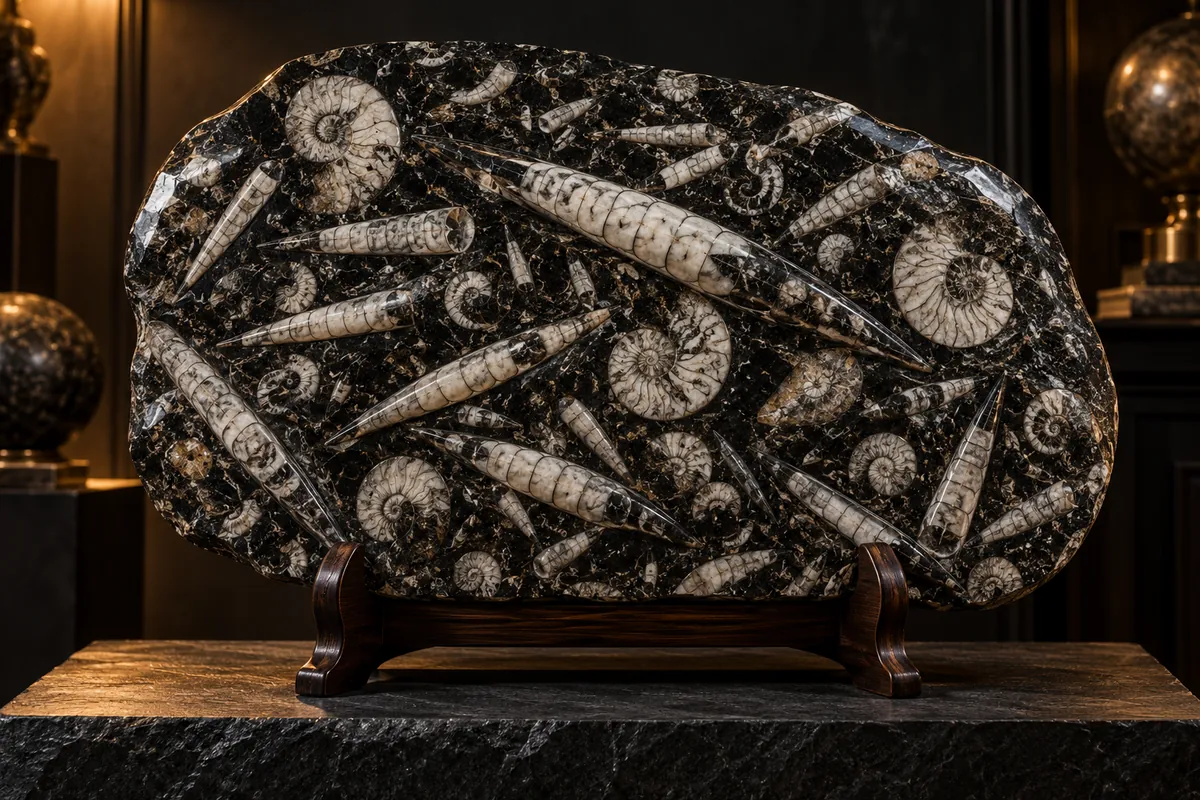
- Black “Orthoceras” stone. Dark limestone packed with straight-shelled orthocerid nautiloids. In the Tafilalt, orthocerid-rich beds are mostly late Silurian to earliest Devonian, roughly 425–410 million years old[3]. See Orthoceras for the animals themselves.
- Brown “goniatite” stone. Late Devonian (Famennian) limestone with coiled ammonoids. The Gonioclymenia Limestone of the Tafilalt is one of the commercially exploited beds[2]. Its name-giving ammonoids are clymeniids, a Late Devonian group, though the trade sells them as goniatites.
Because orthocerid beds span the Silurian–Devonian boundary, labels showing “Devonian” for every black slab are not always accurate. We state the age of the stone as precisely as we can.
From quarry to showroom
Blocks are quarried in the Erfoud region and the wider Tafilalt, then sawn into slabs, shaped and polished in local workshops. Fossil marble products include tabletops and coffee tables, sinks and basins, tiles, vases, bowls, spheres, bookends and wall panels.
One point deserves honesty. On large slabs sold in rock shops, groupings of different fossils can be artificial assemblages rather than a natural seafloor. Some decorative plates have fossils set into the stone or carved in relief from it. These are legitimate decor objects, but they should not be presented as natural fossil beds. Our listings say whether a piece is a natural cut through the rock or an arranged or carved composition.
| Scientific name | Orthocerid nautiloids; clymeniid and other ammonoids (e.g. Gonioclymenia) |
|---|---|
| Geological age | Black stone mostly late Silurian–earliest Devonian (about 425–410 Ma); brown Gonioclymenia stone Late Devonian (Famennian, about 365 Ma) |
| Formation | Siluro-Devonian orthocerid limestones; Gonioclymenia Limestone |
| Locality in Morocco | Erfoud region and the Tafilalt Platform, eastern Anti-Atlas |
| Typical size | Small objects 5–20 cm; slabs, sinks and tabletops up to about 2 m |
Care tips
- Avoid acids. Limestone is calcium carbonate; vinegar, lemon juice, wine and many bathroom cleaners etch the polish. Use water and a pH-neutral soap.
- Seal working surfaces. Sinks, basins and tabletops should be sealed with a stone sealer and resealed periodically.
- Protect from scratches and heat. Use coasters and mats; limestone is softer than granite.
- Restore the shine with a stone polish or wax made for marble and limestone.
Ordering
Heavy decor ships with export paperwork; ask about packing and freight, and see Shipping. Interior designers and shops can order made-to-size pieces through Request a Quote or apply for a wholesale account. For the fossils on their own, browse goniatites and crinoids.
References
- Gutiérrez-Marco, J.C. & García-Bellido, D.C. (2018, online; volume 2022). The international fossil trade from the Paleozoic of the Anti-Atlas, Morocco. In: Hunter, A.W. et al. (eds), The Great Ordovician Biodiversification Event: Insights from the Tafilalt Biota, Morocco. Geological Society, London, Special Publications 485. doi:10.1144/SP485.1
- Hartenfels, S. & Becker, R.T. (2018). Age and correlation of the transgressive Gonioclymenia Limestone (Famennian, Tafilalt, eastern Anti-Atlas, Morocco). Geological Magazine 155(3): 586–629. doi:10.1017/S0016756816000893
- Kröger, B. (2008). Nautiloids before and during the origin of ammonoids in a Siluro-Devonian section in the Tafilalt, Anti-Atlas, Morocco. Special Papers in Palaeontology 79: 1–110. palass.org (publisher record)
Frequently asked questions
Is Moroccan fossil marble real marble?
No. Geologically it is limestone, a sedimentary rock. True marble is metamorphic, and its fossils are destroyed. Moroccan fossil stone is dense enough to take a marble-like polish, which is why the trade calls it marble. The fossils in it are real shells, roughly 425 to 365 million years old depending on the stone.
How do I clean an Orthoceras sink or table?
Use water and a pH-neutral soap. Avoid vinegar, lemon, bleach and acidic bathroom cleaners, which etch limestone. Seal sinks and tabletops with a stone sealer and reseal periodically. Wipe up spills promptly, use coasters, and restore the shine with a polish made for marble and limestone.
Are the fossils in decor slabs natural?
In many pieces the fossils are a natural cut through the rock. Some plates, however, have fossils arranged, set into the stone or carved in relief, and mixed-fossil slabs can be artificial assemblages. Both are genuine fossil material, and our listings state which kind each piece is.
Can you make fossil decor to custom sizes?
Ask through Request a Quote with the dimensions and quantities you need. Whether a tabletop, basin or wall panel can be cut to size depends on the blocks available at the time. Heavy pieces ship with export paperwork, and lead time and freight depend on size, finish and destination.